
Explore how European denim sourcing is shifting in 2026, with recent import figures revealing changes in supplier competitiveness across Bangladesh, Türkiye, Egypt, China, and Pakistan.
European brands reviewing their denim sourcing strategies need to look beyond a supplier’s quoted price. Factory capabilities, fabric availability, washing and finishing options, production capacity, and delivery timelines all affect the final cost and feasibility of an order.
At Deepwear, we help brands assess manufacturing partners and compare sourcing options across different markets. Recent European import figures offer a useful starting point: they show which countries are strengthening their positions in the market and where supplier competitiveness is changing.
The figures do not explain why individual brands choose one factory over another. They do, however, provide a clearer picture of the countries worth examining when planning denim garment manufacturing.
In this blog, we cover:
- Recent changes in European denim imports
- The countries gaining and losing market share
- What these shifts reveal about manufacturing competitiveness
- What brands should evaluate before selecting a denim supplier
European Denim Imports: The Latest Figures
Between January and September 2026, reported EU imports of denim products reached approximately €3.42 billion, a 3.24% decrease compared with the same period in 2025.
The country-level figures show different performances among the leading suppliers.
|
Supplier country |
EU import value |
Year-on-year change |
Market share |
|
Bangladesh |
€1.01 billion |
-5.48% |
29.48% |
|
Pakistan |
€609.70 million |
-6.63% |
17.85% |
|
Türkiye |
€498.10 million |
-20.27% |
14.58% |
|
China |
€230.54 million |
+20.23% |
6.75% |
|
Egypt |
€225.76 million |
+34.97% |
6.61% |
Source: Textile Focus, November 19, 2026, reporting Eurostat data compiled by Bangladesh Apparel Voice. The source describes these figures as EU denim-product imports but does not clearly specify the full customs-code coverage. They should therefore be read as reported market figures, not as a comparison of one narrowly defined denim garment category.
Bangladesh and Pakistan continue to hold substantial positions in the European market. Türkiye remains a major supplier, although its reported imports declined considerably. These figures provide a market overview, not a direct record of brands transferring orders between countries. They also do not capture every relevant manufacturing destination. Morocco and Tunisia, for example, remain important to the nearshore sourcing discussion even though they do not appear among the five largest suppliers in this dataset.
Established Asian Suppliers: Scale and Manufacturing Capacity
1. Bangladesh and Pakistan
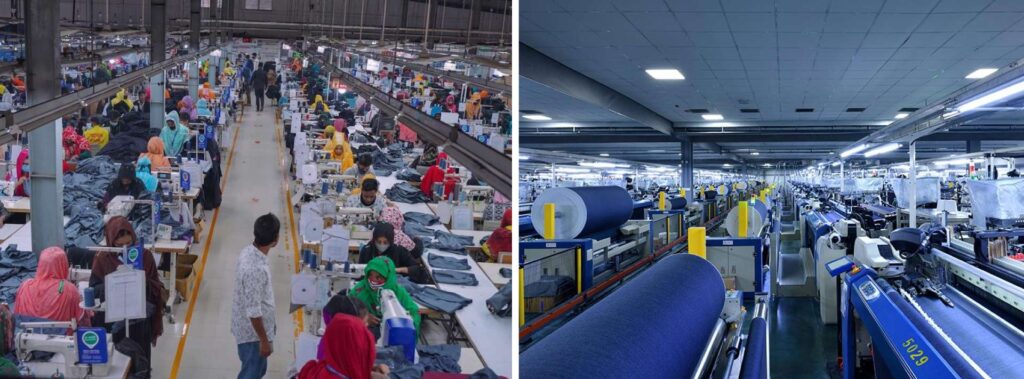
Bangladesh and Pakistan are major suppliers for European brands seeking established garment manufacturing capacity and competitive production costs.
Both markets have established textile and apparel industries. However, factory capabilities differ, particularly in fabric sourcing, washing, finishing, product development, and production flexibility.
For European buyers, these countries remain relevant for larger production programs where cost and manufacturing capacity are central considerations. Brands should assess the factory’s complete production setup rather than assume that every supplier offers the same level of vertical integration.
2. China
China’s broad industrial ecosystem offers access to textile materials, garment manufacturing, machinery, and specialized production processes.
China is worth considering for brands that require a wide range of material and manufacturing options. The decision should account for the product’s target cost, order volume, shipping arrangements, and sourcing requirements.
These established Asian markets remain important alternatives to European nearshoring. Our blog, The Global Manufacturing Reset: Where Fashion Brands Are Producing in 2027, examines the wider shifts influencing production decisions.
Nearshore Denim Manufacturing: Türkiye and North Africa
Nearshore sourcing can help European brands reduce transport distances and coordinate more closely with production partners. Türkiye, Morocco, Tunisia, and Egypt are established markets to examine, although their capabilities and commercial conditions differ.
3. Türkiye: An Established European Sourcing Partner
Türkiye combines textile production, garment manufacturing, washing, and finishing capabilities. Its proximity to European markets supports road freight connections and can make supplier coordination more practical.
However, its recent trade performance deserves attention. Reported EU denim-product imports from Türkiye fell 20.27% year over year between January and September 2026.
This does not make Türkiye an unsuitable sourcing destination. It does mean that brands should evaluate current factory pricing, capacity, and production performance rather than rely on its historical position as a leading nearshore supplier.
Our blog, Turkey’s Manufacturing Reset: Why Nearshoring, Compliance, and Vertical Integration Still Matter in 2026, explores the wider pressures affecting the country’s manufacturing sector.
4. Egypt: A Growing Regional Alternative
Egypt’s growth is worth monitoring, particularly for brands comparing regional production alternatives. However, trade growth alone does not establish whether a specific factory can meet a collection’s requirements.
Buyers should verify fabric access, garmenting capacity, washing facilities, compliance documentation, and export experience.
5. Morocco: Proximity and Established Apparel Manufacturing
Morocco is relevant to European brands looking for geographically closer garment production. Its location supports access to European markets, while its apparel sector has experience serving international buyers.
Its denim trade performance has been less consistent. EU imports of men’s cotton denim jeans from Morocco declined 38.5% between 2015 and 2025, This is a useful reminder that a country’s broader apparel manufacturing position does not necessarily translate into growth in every product category.
Morocco should be assessed at the factory level, particularly for denim-specific equipment, fabric access, washing capabilities, and production capacity.
6. Tunisia: A Nearshore Market Worth Comparing
Tunisia offers another option for European brands evaluating North African manufacturing. Its proximity to Europe and established apparel industry make it relevant to shorter-distance sourcing strategies.
In the same 2015–2025 men’s cotton denim jeans dataset, EU imports from Tunisia increased 12.1%. This contrasts with Morocco’s decline over the same period.
The figures suggest different trajectories within the region, but they do not establish which market offers better pricing, capacity, or delivery performance today.
For a broader overview of the region, see our article, The Rise of Morocco and Egypt as Key Garment Manufacturing Hubs.
7. India: A Major Denim Manufacturing Market Beyond Nearshoring
India is not a European nearshore destination, but excluding it from a sourcing comparison would leave out an important manufacturing market.
India has the world’s second-largest installed denim fabric production capacity after China, estimated at approximately 1.6–1.7 billion meters annually. Its industry includes denim mills, textile processing facilities, and garment manufacturers.
Its capabilities can be relevant to brands seeking fabric development, cotton-based denim, specialized finishes, and garment production. However, integration varies between suppliers. Some mills have extensive fabric capabilities but do not offer the garmenting capacity required for full-package production.
India is therefore best evaluated as a broader sourcing alternative rather than grouped with Türkiye or North Africa. European buyers should also monitor the implementation and commercial implications of the India–EU trade agreement announced in January 2026. Preferential access should not be assumed until the relevant provisions are in force and applicable to the product’s origin and customs classification.
What European Brands Should Compare Before Choosing a Supplier
Country-level trade performance can help identify markets worth investigating. The final decision depends on whether a factory can meet the technical and commercial requirements of the collection.
|
Evaluation area |
What brands should verify |
|
Fabric availability |
Denim composition, weight, construction, color, and material consistency |
|
Garment manufacturing |
Experience with the required silhouettes, construction details, and specifications |
|
Washing and finishing |
Available treatments, equipment, sample consistency, and bulk repeatability |
|
Factory MOQs |
Minimums for fabric procurement, garment production, and specialized finishes |
|
Production lead times |
Material sourcing, sampling, approvals, bulk production, and finishing schedules |
|
Quality assurance |
Inspection procedures, measurement tolerances, testing, and defect handling |
|
Total landed costs |
Production, materials, freight, duties, and other applicable charges |
Fabric availability deserves particular attention. A garment factory may have strong sewing capabilities but depend on external mills for denim. This adds supplier coordination and can affect the production schedule. Our guide, Beyond Fabric Sourcing: How Material Availability Affects Fashion Manufacturing, explains why material access needs to be considered alongside factory selection.
Brands considering shorter supply routes should also account for the practical limitations of nearshoring. Proximity does not automatically translate into lower manufacturing costs, available capacity, or faster production. Our guide, Navigating the Challenges of Nearshoring: Garment Manufacturers, examines these considerations.
Comparing denim factories across different markets? Deepwear can help assess potential suppliers against your product specifications, order quantities, and production requirements. Contact our team to discuss your sourcing options.
How Deepwear Supports European Denim Sourcing
Deepwear connects fashion brands with factories, suppliers, and artisans across its international sourcing network. We do not own factories or manufacture garments. Our role is to help brands identify suitable production partners, assess manufacturing capabilities, and coordinate sourcing and production.
For European clients, this can include comparing established Asian suppliers with nearshore options in Türkiye and North Africa, or assessing broader alternatives such as India. We consider the requirements of each collection, including materials, factory capabilities, MOQs, costs, and logistics.
Our approach to Strategic Sourcing in Apparel Manufacturing: Why Nearshoring Is Accelerating Under Geopolitical Pressure also explores why brands need to evaluate sourcing decisions across their wider supply chains.
Which countries are important for European denim sourcing?
Bangladesh, Pakistan, China, and Türkiye are major suppliers in reported EU denim-product import figures. Egypt is also gaining ground. For nearshore manufacturing, brands should additionally assess Morocco and Tunisia.
Is nearshore denim manufacturing always cheaper?
No. Shorter transport routes can reduce some logistics costs, but factory pricing, materials, energy, labor, order quantities, and production efficiency all affect total landed costs.
Plan Your Next Denim Production
European denim sourcing involves more than choosing between established Asian suppliers and geographically closer manufacturing markets. Türkiye, Egypt, Morocco, and Tunisia offer different nearshore possibilities, while India remains a significant broader sourcing alternative.
The right choice depends on the collection, factory capabilities, order volume, target cost, and delivery requirements. A country’s trade performance can help guide the search, but supplier-level evaluation should determine the final decision.
It only takes a handful of questions to get started. Book a consultation with our team to discuss your denim manufacturing requirements and explore suitable sourcing options.