
Discover textile innovations moving towards commercial production, from technical wool and citrus-derived fibres to smart textiles and protective materials.
Fashion brands do not need to wait for a material to become mainstream before investigating its potential. Some textile innovations are already available through specialist suppliers, while others have reached pilot production, limited commercial releases or advanced research stages. The challenge is determining which developments can meet a collection’s technical, financial and manufacturing requirements.
The difference between a promising laboratory result and a commercially viable textile often comes down to production consistency, supplier availability, processing requirements and cost. A material might demonstrate excellent performance in a controlled experiment yet require specialised equipment, expensive inputs or manufacturing processes that limit its practical use.
At Deepwear, we approach textile innovation through the realities of sourcing and manufacturing. A material’s technical capabilities matter, but so do its availability, compatibility with existing production processes and suitability for the intended product.
This article launches our Textile Innovations series, exploring materials and technologies at different stages of development. Future installments will examine textiles still under development, genuinely innovative materials with scientific backing, and technologies already reaching the market, even in limited quantities. The aim is to distinguish credible progress from speculation and identify developments worth investigating for future collections.
In this blog we cover:
- Commercially available textiles with engineered performance benefits.
- Alternative textile materials with documented product applications.
- Emerging technologies that have demonstrated technical potential.
- Manufacturing considerations affecting scalability, cost and sourcing.

How Deepwear Approaches Emerging Textile Technologies
At Deepwear, we look beyond the technical claims surrounding a new material to assess what it means for actual product development. Our team works with brands to identify suitable suppliers, compare material specifications, coordinate sampling and connect material choices with manufacturing capabilities.
For established textiles, this may involve sourcing the right fabric construction for a particular garment. For emerging technologies, it can mean investigating commercial availability, identifying specialist development partners and determining what further validation is needed before production.
This approach helps brands distinguish between materials they can explore for an upcoming collection and those that require longer-term monitoring.
1. OPTIM™ Merino Wool: Engineering Weather Resistance into Natural Fibres
OPTIM™ demonstrates how an established natural fibre can acquire new performance characteristics through changes to processing and fabric construction.
Developed through collaboration between Nanshan and Woolmark, OPTIM uses pre-stretched Merino wool fibres that are spun into yarn and woven into a dense fabric. During wet finishing, the fibres relax, causing the yarns to contract and the fabric structure to tighten. This creates wind- and water-resistant properties without relying on conventional durable water-repellent treatments.
The technology is commercially available in several fabric constructions, including 100% Merino wool and selected blends. Woolmark identifies applications ranging from outdoor jackets to tailoring, smart-casual clothing and other performance-oriented garments.
What brands can investigate:
- Merino outerwear and lightweight jackets.
- Premium technical tailoring.
- Smart-casual clothing requires some weather resistance.
- Natural-fibre alternatives to selected synthetic outerwear constructions.
The manufacturing assessment should cover fabric weight, drape, seam construction, abrasion resistance, water resistance, care requirements and cost. Brands should also establish whether the selected fabric grade meets the performance requirements of the finished garment.
OPTIM illustrates a practical principle of textile engineering: innovation can emerge from changing how an existing fibre is processed rather than introducing an entirely new raw material.
Looking to incorporate technical natural fibres into your next collection? Our team can help you explore available fabric constructions, compare specifications and identify suitable manufacturing partners for your product. Start a conversation with our team.
2. Ventile® Cotton: Performance Through Fabric Construction
Ventile offers another example of established textile technology that remains relevant to contemporary apparel development.
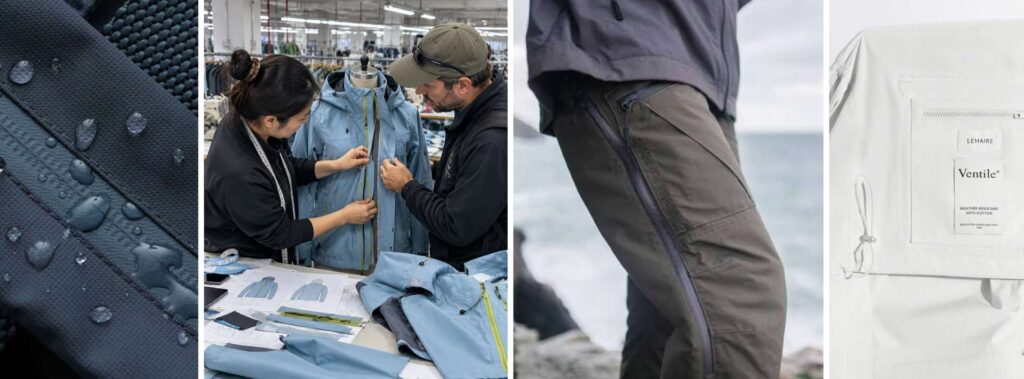
Originally developed in Britain during the Second World War for military flight clothing, Ventile uses densely woven cotton to provide resistance to water penetration. When exposed to moisture, the cotton fibres swell, reducing the spaces between them and improving the fabric’s resistance to water.
Unlike a conventional waterproof membrane system, its principal mechanism relies on the properties of cotton and the construction of the fabric itself.
Ventile is an established commercial material used in technical outerwear and premium clothing. Its relevance extends to brands exploring natural-fibre alternatives to certain synthetic shell fabrics.
Potential applications include:
- Premium rain-resistant jackets and coats.
- Outdoor and travel clothing.
- Heritage-inspired outerwear.
- Natural-fibre technical garments.
Performance varies by construction. Fabric weight, weave density, seam design and exposure conditions influence how a finished garment performs. Water resistance should not be confused with complete waterproofness, particularly during prolonged exposure to heavy rain.
For apparel brands, the development process should begin with the intended use. A lightweight travel jacket, a heritage-inspired coat and a garment designed for sustained exposure to severe weather have different requirements.
Sampling and testing should assess the specific fabric grade against those requirements before the brand commits to bulk production.
Ventile demonstrates that innovative fabrics do not always need newly developed fibres. Improvements in fabric engineering can offer practical performance benefits while retaining familiar raw materials.
3. Orange Fiber: Turning Citrus By-Products into Textile Materials
Orange Fiber approaches textile innovation through an alternative raw-material stream.
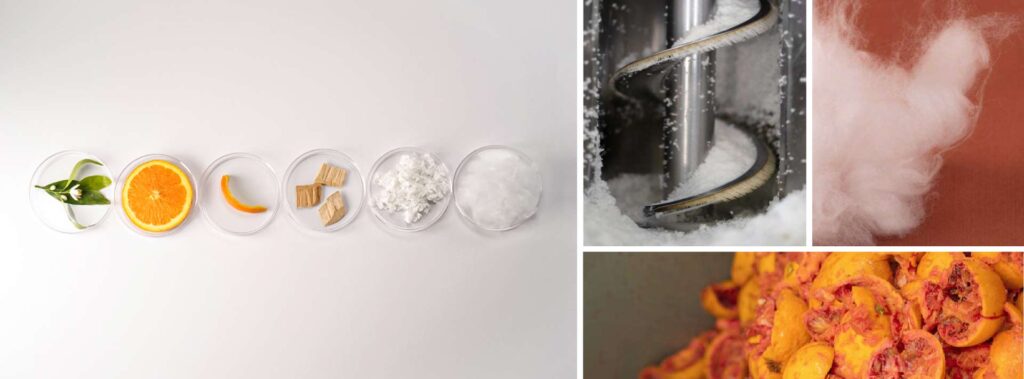
The Italian company developed a process for recovering cellulose from citrus-processing by-products and converting it into textile materials. Its work connects agricultural and food-processing waste streams with fibre development, spinning and fabric production.
One significant development was its collaboration with Lenzing on TENCEL™ Limited Edition x Orange Fiber, combining citrus-derived cellulose with wood-based cellulose to produce lyocell fibre.
The material has also appeared in documented fashion and accessory collections, including collaborations involving Salvatore Ferragamo, H&M Conscious Exclusive and E. Marinella.
These examples demonstrate that citrus-derived textile materials have progressed beyond laboratory concepts into finished products. They do not, however, establish that every Orange Fiber construction is available at the volume or price required for conventional mass-market apparel.
What brands should verify:
- The precise fibre composition of the finished material.
- Available fabric constructions and specifications.
- Minimum order quantities and repeat-order capacity.
- Feedstock availability and processing consistency.
- Lead times and commercial pricing.
- Supporting evidence for environmental claims.
Using a by-product does not automatically prove lower lifecycle impacts. Processing energy, chemicals, water consumption and the alternative uses of the feedstock all influence the overall result.
For premium apparel and accessories, alternative feedstocks can provide material differentiation and a documented development story. Their commercial value still depends on whether the fabric meets the product’s requirements and can be sourced consistently.
Orange Fiber provides a useful case study in the relationship between sustainable textile innovation, industrial partnerships and commercial scale.
Exploring alternative fibres for a new collection? Deepwear can help you investigate material availability, assess supplier capabilities and coordinate sourcing around your product requirements.
4. R|Elan™: Evaluating Commercial Fibre Technologies
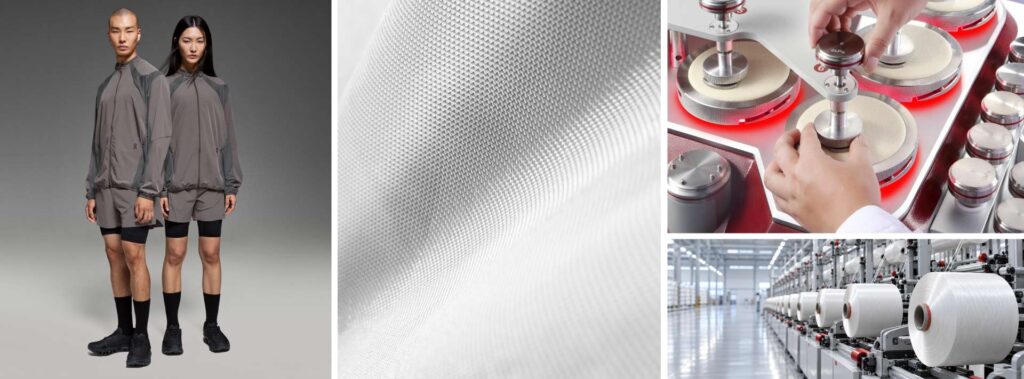
R|Elan™, a textile brand within Reliance Industries’ portfolio, represents a different approach to innovation. Rather than referring to one material with a single composition, it encompasses a range of speciality fibre and fabric technologies.
This makes product-level evaluation essential. A claim about one grade cannot automatically be applied to the entire portfolio.
For brands, the first step is to identify the specific product and obtain its technical documentation. Relevant details include fibre composition, functional properties, recycled content where applicable, testing methods, processing compatibility and commercial availability.
For example, a brand evaluating a specialty polyester fabric should compare its performance against the existing material across abrasion, pilling, dimensional stability, dyeing, hand feel and cost.
Any claimed environmental advantage should also be supported by evidence appropriate to the particular material and comparison.
A supplier’s ability to provide a sample does not necessarily demonstrate that it can deliver the required quantity consistently. Brands should establish production capacity, lead times, minimum quantities and the availability of repeat orders before approving the material for a collection.
R|Elan is therefore a useful example of a commercial textile platform that warrants investigation, although individual products must be assessed on their own technical and sourcing merits.
5. Conductive Embroidery and Textile-Based Touch Interfaces
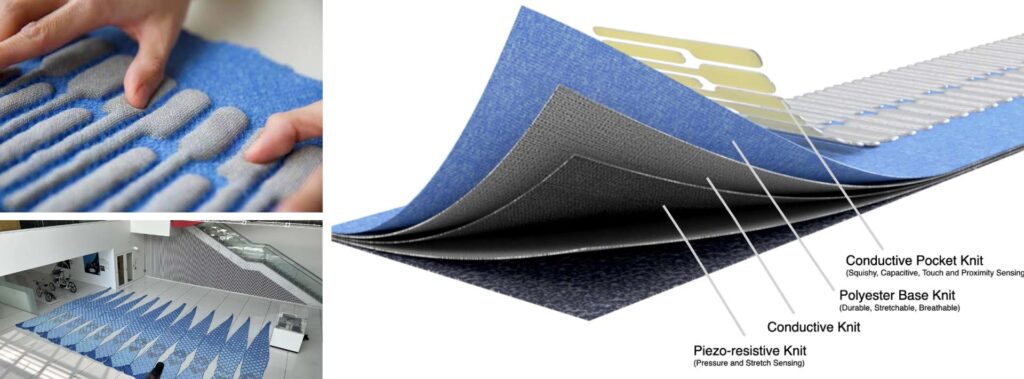
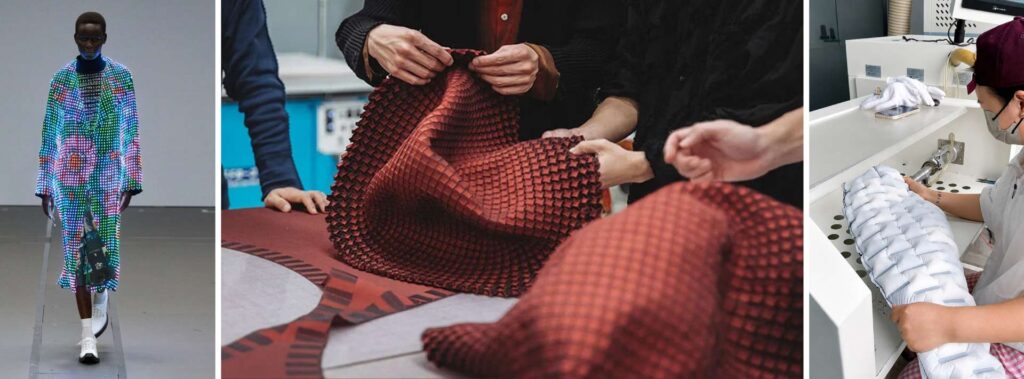
Electronic textiles, or e-textiles, integrate electrical functionality into textile structures through conductive yarns, threads, inks and other components. Conductive embroidery is one way to create electrical pathways or sensing areas within a fabric.
Research has demonstrated textile interfaces that respond to touch, pressure and proximity. MIT Media Lab’s KnittedKeyboard project, for example, explored digitally knitted textile structures as interactive musical controllers. Other studies have demonstrated conductive silk yarns used in embroidered and woven touch sensors.
These developments open possibilities for interactive performance costumes, wearable controls, specialist sportswear and other products where a textile’s function extends beyond covering the body.
What manufacturing needs to address
- Conductivity: Electrical resistance must remain within acceptable limits.
- Connections: Conductive thread must connect reliably to electronic components.
- Washability: Washing, moisture and repeated flexing can affect conductive pathways.
- Comfort: Components must not create uncomfortable pressure points or stiff areas.
- Repeatability: Stitch patterns and thread placement must remain consistent across production runs.
- Electronics integration: Power, batteries, control boards and repair access require consideration.
For conventional apparel, the most realistic initial applications may be limited collections, performance garments or accessories developed with specialist technology partners. Larger production runs require repeatable assembly processes and evidence that the finished product can withstand its intended use.
Conductive embroidery is an example of smart textile innovation with demonstrated technical potential, although commercial readiness varies by application.
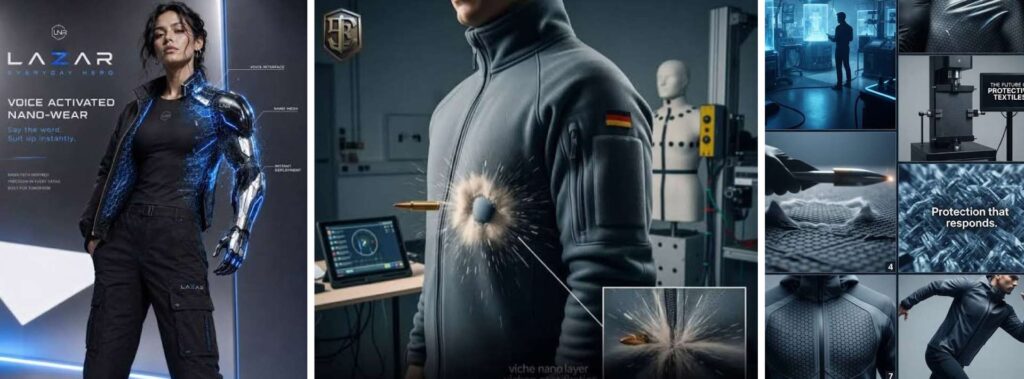
6. Liquid Armor: Protective Textiles at a Specialist Development Stage
Liquid Armor is a broad term often associated with shear-thickening fluids (STFs), which become more resistant to flow under particular conditions of applied shear.
Researchers have investigated incorporating these fluids into high-strength fabrics, including aramid textiles, to influence how yarns move and how impact energy is distributed. The technology has attracted attention in research into flexible protective materials.
A 2024 experimental study examined different fluid formulations in Kevlar-based structures. Its results showed that performance depended on the formulation and arrangement of the layers. The findings reinforce the need to evaluate the complete textile composite rather than assuming that adding a shear-thickening fluid automatically improves protection.
Where the technology could be applied
- Specialist protective equipment.
- Certain occupational garments.
- Impact-resistant panels and protective accessories.
- Selected applications requiring flexibility alongside mechanical protection.
The manufacturing requirements differ considerably from conventional apparel. Brands need to establish whether a suitable commercial product exists, what threats it is designed to address, and whether the finished garment has been tested against applicable standards.
Weight, flexibility, ventilation, environmental stability and maintenance also influence its suitability.
Liquid Armor is therefore best understood as a specialist protective-material technology, with ongoing research and application-specific development requirements. Its inclusion in this series reflects its technical significance rather than implying that it is ready for routine apparel production.
Developing a product that requires specialized material performance? Deepwear can help investigate relevant sourcing options and manufacturing capabilities, including where specialist technical partners may be required. Contact our team.
From Laboratory Research to Commercial Production
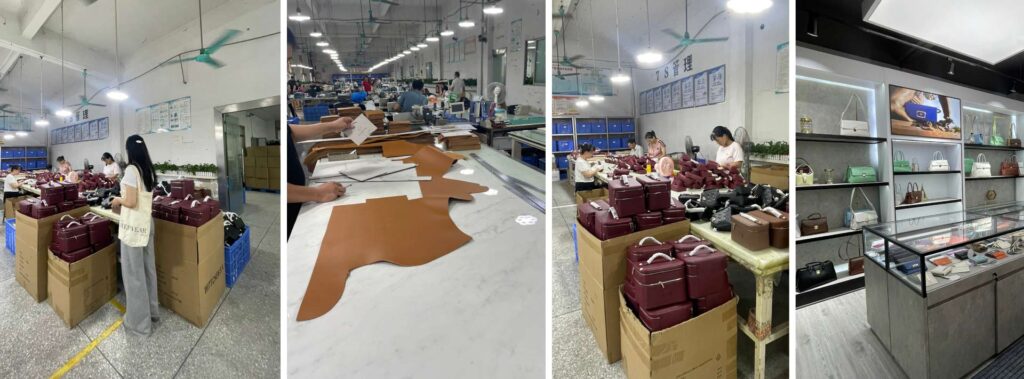
One of the biggest challenges in textile manufacturing innovation is moving from a successful experiment to a material that can be produced consistently and incorporated into finished garments.
A textile that performs well in a controlled laboratory environment may encounter different conditions when processed at industrial scale. The transition involves several stages:
|
Development stage |
What needs to be established |
|
Laboratory validation |
The material demonstrates the intended technical properties. |
|
Pilot production |
The process can produce larger quantities with consistent specifications. |
|
Textile processing |
Spinning, weaving, knitting, dyeing and finishing can be performed reliably. |
|
Garment development |
The material works in an actual product, including seams, construction and care requirements. |
|
Bulk production |
Suppliers can maintain quality, capacity, repeatability and commercially workable costs. |
Consider conductive embroidery. A researcher might successfully produce a functioning touch sensor on a small textile sample. A manufacturer must then reproduce the electrical pathways consistently, integrate electronic components and establish that the finished garment can withstand repeated movement and washing.
Orange Fiber presents a different challenge. Its commercial development depends on securing consistent feedstock and maintaining material specifications through industrial processing.
These examples demonstrate why technical feasibility and commercial readiness need separate evaluation.
What Can Make Innovative Textiles Difficult to Scale?
Even when a material demonstrates promising performance, several factors can prevent its adoption in larger production runs.
1. Raw-material availability
Alternative fibres and specialised feedstocks may be available only in limited quantities. This can make repeat orders difficult, particularly when a collection requires consistent colors, weights and fabric specifications.
2. Manufacturing compatibility
Some innovations require new machinery, specialised finishing processes or additional technical expertise. Existing textile mills may not be equipped to accommodate them without investment.
3. Performance trade-offs
Improving one characteristic can affect another. A denser fabric may offer better weather resistance but increase weight. Conductive components may provide interactive functions while introducing additional care and durability requirements.
4. Production economics
Research, sampling, specialist processing and quality assurance can increase development costs. Brands must assess whether the resulting product offers sufficient value to justify those expenses.
5. Market demand
A technically successful textile still needs a product application and customer base that justify commercial investment. Limited demand can discourage suppliers from expanding production capacity.
For brands, understanding these barriers early can prevent unnecessary development costs and unrealistic production expectations.
What Should Brands Verify Before Adopting a New Textile?
Before incorporating a new material into a collection, brands should establish whether its technical advantages translate into measurable product benefits.
Our team would prioritise the following checks during material evaluation:
|
Assessment area |
Questions to ask |
|
Availability |
Can the material be sourced now, and in what quantities? |
|
Supplier capability |
Can the supplier reproduce the specification across batches? |
|
Composition |
What fibres, coatings, treatments or additional components are involved? |
|
Performance |
Does the textile meet the intended requirements for comfort, durability and function? |
|
Manufacturing |
Can existing partners process it, or are specialist facilities needed? |
|
Cost and timing |
Do material prices, sampling expenses, MOQs and lead times fit the collection plan? |
|
Documentation |
Are technical and environmental claims supported by relevant evidence? |
Testing should reflect the intended product. A technical outerwear fabric needs appropriate weather-resistance and durability assessments, while a textile-based touch interface requires electrical and laundering tests.
For sustainability claims, brands should request documentation covering the actual fibre composition, feedstock origin, relevant certifications and the scope of any environmental assessment.
A supplier’s promotional material is a starting point for investigation, not a substitute for technical documentation.
Which Innovations Are Worth Exploring for Upcoming Collections?
Not every textile innovation needs to be ready for mass production to be relevant to a brand. The appropriate choice depends on the product category, development budget, manufacturing capabilities and launch timeline.
The following comparison provides a practical starting point:
|
Brand objective |
Technologies to investigate |
Development considerations |
|
Premium weather-resistant outerwear |
Ventile, OPTIM |
Fabric construction, weather performance and garment design |
|
Natural-fibre technical clothing |
OPTIM |
Fabric availability, finishing and durability |
|
Alternative material positioning |
Orange Fiber |
Fibre composition, sourcing capacity and pricing |
|
Performance and interactive fashion |
Conductive embroidery |
Electronic integration, washability and specialist manufacturing |
|
Specialist protective apparel |
Liquid Armor / STF |
Certified performance, formulation and technical validation |
|
Functional synthetic-fibre development |
Selected R|Elan grades |
Product specifications, processing compatibility and supplier capacity |
For collections scheduled in the near term, established commercial fabrics such as Ventile and OPTIM provide more straightforward starting points for sourcing and sampling.
Orange Fiber offers a more specialised opportunity for brands interested in alternative feedstocks and differentiated material development. R|Elan requires identifying the relevant product grade before its benefits can be assessed.
Conductive embroidery and Liquid Armor are better suited to projects with specific functional requirements and access to specialist development partners.
These distinctions are not permanent. As research progresses, supplier capacity expands and manufacturing costs change, materials currently available only through specialist channels may become more accessible.
Where Deepwear Fits into Textile Innovation
The technologies explored in this article illustrate how different stages of textile development can influence future product decisions. Some, such as Ventile and OPTIM, offer established options for brands developing technical apparel. Others, including citrus-derived fibres and conductive embroidery, present more specialised opportunities that depend on supplier access, production capabilities and intended applications. Technologies such as Liquid Armor also demonstrate why research progress should be distinguished from commercial readiness.
For brands, keeping track of these developments can inform material selection, product differentiation and longer-term collection planning. It also provides an opportunity to identify potential material partners before a technology becomes widely adopted, while maintaining realistic expectations about availability, performance and cost.
Our previous blog, 8 Key Textile Industry Trends Shaping Apparel Manufacturing in 2026, examines developments influencing material selection and apparel production. Meanwhile, Beyond Fabric Sourcing: How Material Availability Affects Fashion Manufacturing explores the practical consequences of material availability, supplier capacity and lead times.
For materials still in development, Spider Silk and the Future of Fashion: Can Next-Generation Materials Transform Textile Manufacturing? examines why technical promise alone does not establish commercial scalability.
This Textile Innovations series will continue exploring materials at different stages of development, including research-led concepts, limited commercial releases and established technologies that offer new possibilities for apparel manufacturing.
Considering a new textile for your next collection? Deepwear can help you investigate material options, identify suitable suppliers and coordinate product development around your technical and commercial requirements. Book a consultation with our team to discuss your next project.