
Discover five emerging textile technologies that could transform fashion in the next decade, from soft robotic garments and water-harvesting fabrics to root-grown materials, engineered spider silk and 3D-printed clothing.
The next generation of textile innovation is challenging established assumptions about what clothing can do, what materials garments can be made from, and how they can be manufactured.
Researchers are developing textiles that assist human movement, harvest moisture from the atmosphere, and integrate energy-generating capabilities. Elsewhere, biological engineering is making it possible to grow textile-like structures from plant roots and reproduce spider silk proteins through controlled production systems. Advances in additive manufacturing are also creating new possibilities for producing garments with complex structures and customized properties.
Some of these developments have moved beyond theoretical research. University laboratories have demonstrated functional prototypes, engineered biological materials have been spun into fibres, and researchers have developed textile structures capable of performing specialized functions. Nevertheless, the distance between a successful laboratory experiment and a commercially viable material remains considerable.
This blog is Part 2 of our Textile Innovation Series, which explores emerging textile technologies, genuine scientific developments and materials that could influence the future of fashion and manufacturing. Part 1 examined innovations with more immediate development and commercial potential. This instalment looks further ahead, focusing on technologies undergoing research, engineering refinement and early-stage development.
The five-to-ten-year timeframe represents a research and commercialization horizon, not a prediction that all five technologies will reach mass production within that period.
In this blog, we cover:
- Soft robotic and energy-generating textiles that could make garments assist movement and power wearable electronics.
- Atmospheric water-harvesting fabrics designed to collect moisture from the surrounding air.
- Root-grown textiles and how biological fabrication could create new material structures.
- Engineered spider silk and advances in producing high-performance biological fibres.
- 3D-printed fashion and the potential of additive manufacturing to change garment construction.
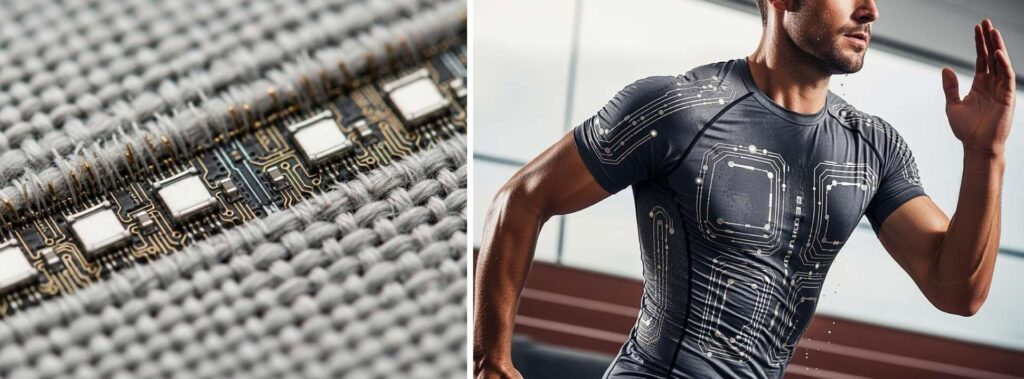
How Deepwear Follows the Future of Textile Development
At Deepwear, we recognize that material innovation can influence fashion long before a new textile reaches commercial production. Understanding these developments gives brands an opportunity to consider future product directions, explore new applications and anticipate changes in manufacturing requirements.
Through our work with manufacturers, suppliers and specialist partners across different markets, we keep material innovation connected to the practical realities of the fashion supply chain. This includes understanding emerging production methods, identifying potential applications and recognising where new technical expertise may be required.
For brands planning beyond their next collection, following these developments can help inform longer-term material strategies and product development priorities:
1. SWAG and Energy-Generating Textiles: When Clothing Becomes Functional Equipment
Clothing has traditionally served as protection, insulation and personal expression. Research into functional textiles, however, is expanding the possibilities of garments by integrating sensing, movement assistance and energy generation.
One particularly interesting European research initiative is SWAG, short for Soft Wearable Assistive Garments for Human Empowerment.
Funded through the European Union’s Horizon Europe programme, the project brings together researchers working in robotics, biomechanics, textile engineering, electronics and artificial intelligence. Its objective is to develop soft robotic garments that support movement without the bulk and rigidity associated with conventional exoskeletons.
The research focuses on inflatable textile structures, integrated sensing systems and distributed actuation. These components are designed to provide assistance to the lower body and core during everyday mobility, physically demanding work, exercise and other activities.
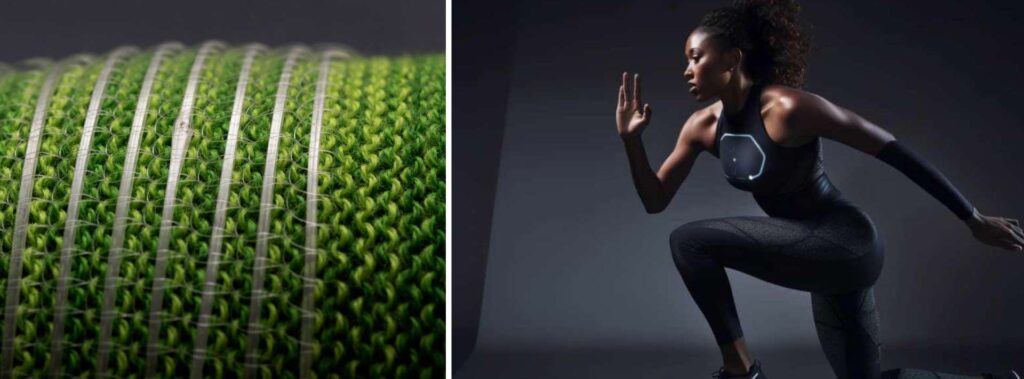
Can clothing generate its own electricity?
A related research direction involves energy-harvesting textiles that convert movement into electrical energy.
A 2026 study published in the Research Journal of Textile and Apparel, titled Design and Synthesis of Energy-Generating Smart Clothing Using Magnetic Textiles, investigated magnetic nanostructures embedded in textile fibres alongside conductive elements that function as inductive coils.
The researchers developed clothing capable of converting mechanical energy from movements involving the hands, legs and torso into electricity. Their prototype demonstrated the ability to power low-energy electronic components, including temperature sensors, Bluetooth modules and heating elements.
This research draws on electromagnetic induction and triboelectric effects, both of which are being explored in wearable energy systems.
Potential applications include performance clothing with integrated sensors, garments supporting rehabilitation, and workwear capable of powering low-energy monitoring devices.
What needs to happen before commercialization?
The principal challenges involve comfort, flexibility, washing durability, electrical safety, battery integration and manufacturing complexity.
Soft robotic garments also require reliable control systems and actuators that can operate repeatedly without compromising the textile structure.
For energy-generating clothing, researchers must improve power output, energy storage and conversion efficiency. A prototype powering a small sensor does not establish that a garment can independently supply the energy demands of more sophisticated electronics.
What brands should monitor: Developments in conductive fibres, flexible electronics, washable connections, textile-integrated sensors and specialized fabric manufacturing. Brands exploring performance apparel and assistive wearables should also monitor partnerships between textile manufacturers and engineering laboratories.
For brands exploring functional apparel and wearable technology, finding the right development partners is an important part of product planning. Deepwear can help investigate suitable manufacturing capabilities and connect projects with suppliers equipped to handle specialized product requirements. Start a conversation with our team.
2. Atmospheric Water-Harvesting Garments: Collecting Water From the Air
One of the more unusual developments in advanced textile technology involves fabrics designed to capture moisture from the atmosphere and convert it into usable water.
Atmospheric water harvesting has traditionally relied on specialized sorbent materials that absorb water vapor. Researchers have been investigating ways to improve their absorption capacity, accelerate water collection and integrate them into portable systems.
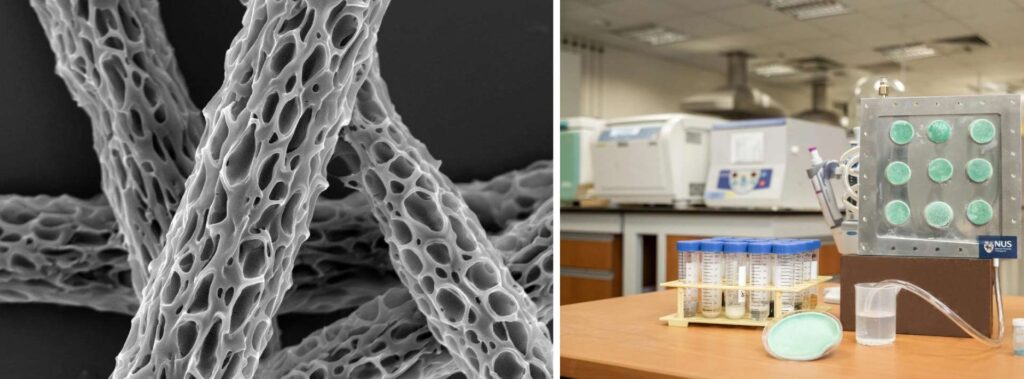
A particularly relevant development appeared in Science Advances in June 2026. Researchers from the University of Texas at Austin and Sichuan University developed hierarchical porous textile fibres designed to capture atmospheric moisture and transport the resulting water efficiently.
The fibres contain open-pore surface structures and internal pore networks that facilitate moisture absorption, condensation and water movement.
When woven into textiles, the material maintained effective vapour diffusion and demonstrated a three-to-tenfold improvement over traditional sorbents at scale.
The researchers also developed a wearable prototype integrating the textile with a portable collection module. Testing across relative humidity levels of 20–80% produced water collection measurements of approximately 410–894 millilitres, depending on the conditions.
These results offer a significant proof of concept for wearable atmospheric water harvesting.
Where could this technology be used?
Potential applications extend beyond everyday clothing.
- Outdoor and expedition apparel: Portable water collection systems for remote environments.
- Military and emergency equipment: Experimental water collection solutions for personnel operating in areas with limited infrastructure.
- Performance clothing: Specialized garments incorporating moisture-management and collection systems.
- Protective workwear: Potential applications for workers operating in challenging environments.
However, the demonstrated prototype includes a portable collection module. It should not be interpreted as an ordinary jacket independently producing drinking water.
The remaining engineering challenges
The amount of water collected depends on atmospheric humidity, temperature, exposure conditions and the properties of the sorbent material.
Other considerations include the energy required to regenerate certain sorbents, water collection efficiency, material durability, weight and the safety of the collected water.
A wearable system must also remain comfortable while accommodating the additional components needed to collect and store water.
What brands should monitor: Research into hygroscopic materials, porous fibre engineering, moisture transport, sorbent regeneration and lightweight collection systems. Product developers should pay particular attention to whether these systems can be integrated into existing garment construction without significantly compromising breathability or mobility.
Developing apparel with specialized moisture-management or collection functions requires careful consideration of material performance and garment construction. Speak with our team about sourcing technical fabrics and identifying manufacturing partners for functional apparel projects.
3. Root-Grown Textiles: Can Plants Become the Fabric?
Biological fabrication is opening another direction for sustainable textile innovation: using living organisms to create material structures rather than manufacturing every component through conventional industrial processes.
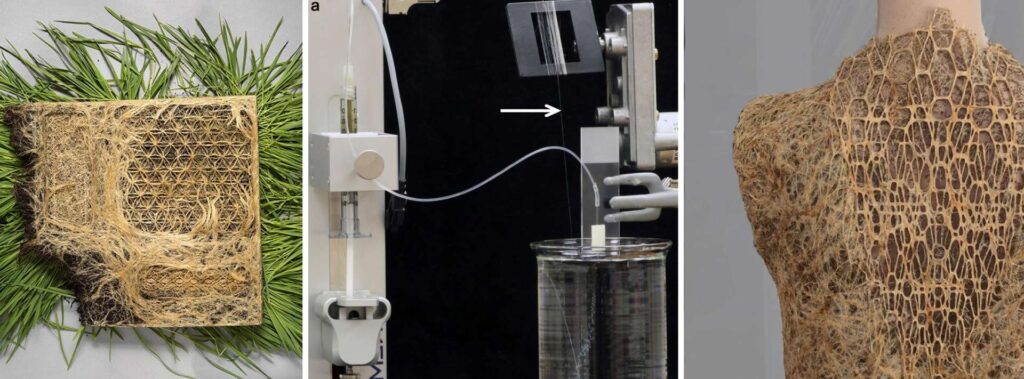
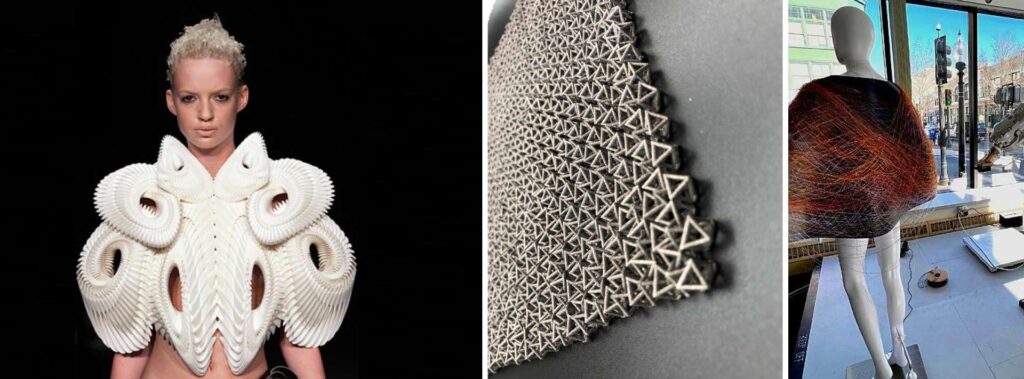
One example is the work of artist and researcher Diana Scherer, who developed a technique for directing plant root growth into controlled patterns.
Working with researchers at Radboud University in the Netherlands, Scherer investigated how plant roots could be guided through specially designed templates to produce intricate, interconnected structures resembling woven textiles.
A 2021 research article in Bio-Design and Manufacturing, titled Digital Biofabrication to Realize the Potentials of Plant Roots for Product Design, examined the potential of plant roots as a material for product fabrication.
The research explored how digital templates could influence root growth and how roots could bind separate structures together. One demonstrated object used plant roots to connect 600 digitally designed bioplastic beads into a self-supporting structure.
This is particularly interesting because the roots contribute to the physical structure rather than simply serving as decorative elements.
What could root-grown materials become?
Potential applications include:
- Experimental biofabricated textiles and textile-like surfaces.
- Lightweight structures for accessories and design objects.
- Decorative panels and sculptural fashion elements.
- Hybrid materials combining biological growth with engineered supports.
The approach also raises questions about how textile production could incorporate controlled biological growth.
Instead of relying entirely on spinning, weaving or knitting, certain structures could be grown into predetermined configurations.
Why mass production remains difficult
Root-grown materials are still experimental.
Plant species, growing conditions, moisture, temperature, nutrient availability and growth duration can all affect the resulting structure. Maintaining consistent dimensions and mechanical properties across batches would be a substantial challenge.
There are also questions about drying, preservation, flexibility, resistance to abrasion, color stability and long-term durability.
A root-grown structure that works as an exhibition object does not necessarily have the properties required for a wearable garment.
The environmental benefits also require independent assessment. Growing conditions, cultivation infrastructure, supporting materials, processing and product lifespan all influence the final environmental impact.
What brands should monitor
Research into biological growth control, root morphology, biofabrication templates, natural fibre reinforcement and hybrid material structures. Design-led brands and accessory developers may find earlier applications than companies seeking to replace conventional fabrics across entire clothing collections.
4. Engineered Spider Silk: Reproducing One of Nature’s Most Intriguing Fibres
Spider silk has attracted scientific attention for its combination of tensile strength, extensibility and toughness relative to its weight.
However, harvesting natural spider silk at industrial volumes is impractical. Spiders are territorial, and conventional spider farming does not offer an efficient route to large-scale fibre production.
Researchers have therefore turned to recombinant spider silk, using genetic engineering to produce spider-silk proteins in other organisms.
These proteins can then be processed into artificial fibres through specialized spinning methods.
Research published in Advanced Functional Materials in 2025 by a team including researchers from Aalto University demonstrated artificial spider-silk fibres produced through an entirely aqueous processing approach.
The resulting fibres achieved a toughness modulus of approximately 120 MJ/m³ and extensibility of 255%.
The research is important because conventional artificial spider-silk production has often relied on organic solvents and complicated post-processing procedures.
A separate 2026 study published in PNAS investigated another obstacle: the cost and efficiency of producing and purifying spider-silk proteins.
Researchers developed engineered mini-spidroins with improved expression yields and a liquid-liquid phase separation purification method. Their approach reduced purification costs by up to 99% compared with conventional affinity chromatography. They also reported protein yields of approximately 25 grams per litre in bioreactor cultivation.
The purified proteins could subsequently be spun into continuous fibres.
These findings represent meaningful progress in the production process, although they do not establish that commercial garment manufacturing is already economically viable.
Potential applications in fashion
The mechanical properties of engineered spider silk could make it relevant to:
- Lightweight performance textiles.
- High-strength technical fabrics.
- Protective clothing and specialized equipment.
- Flexible textile components and accessories.
- Experimental blended fibres for premium applications.
Its suitability will depend on the specific protein formulation and fibre properties achieved during production.
What remains unresolved?
Producing spider-silk proteins is only one stage of textile manufacturing.
The proteins must be converted into fibres with consistent diameter, strength, elasticity and processing characteristics. Researchers must also establish repeatable spinning processes, reliable production yields and competitive manufacturing costs.
Long-term durability, dyeing compatibility, abrasion resistance and performance after repeated washing require further investigation for apparel applications.
Environmental assessments are equally important. Recombinant production requires energy, feedstocks, processing infrastructure and purification systems. A biological origin alone does not establish a lower environmental footprint.
Deepwear has explored the material’s existing research and sourcing implications in Spider Silk and the Future of Fashion: Can Next-Generation Materials Transform Textile Manufacturing?. This broader development also illustrates why emerging materials require careful supplier evaluation and manufacturing feasibility assessments.
What brands should monitor: Improvements in recombinant protein yields, bioreactor production, purification costs, aqueous fibre spinning, fibre consistency and independent performance testing.
5. 3D-Printed Fashion: Moving Beyond Conventional Garment Construction
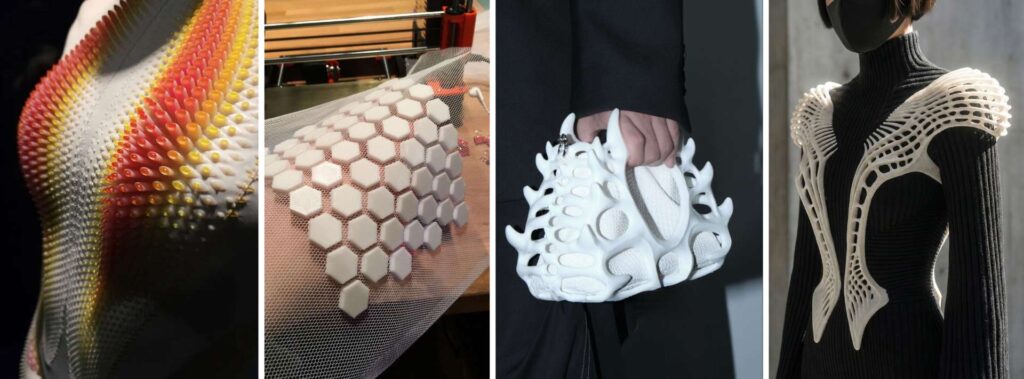
3D printing in fashion has already produced experimental footwear, accessories, garment structures and wearable prototypes. The next challenge is developing materials and processes that can create comfortable, flexible and durable clothing at commercially meaningful volumes.
Unlike conventional garment production, additive manufacturing builds structures through successive layers of material using digital designs.
This creates opportunities for complex geometries, customised structures and localised production.
A 2023 review published in Fashion and Textiles, titled Revolutionising Textile Manufacturing: A Comprehensive Review on 3D and 4D Printing Technologies, examined developments in printed textile structures, functional filaments, printed textile composites and complete garment construction.
The researchers identified considerable potential in customisation and small-scale production, while also describing the gap between laboratory prototypes and scalable manufacturing as a major limitation.
More recent research offers another example.
In 2026, MIT Media Lab researchers presented InSituWear, a robotic fabrication approach that creates personalized wearable structures directly on the body using heated polycaprolactone (PCL) filaments.
The system draws thin filaments into three-dimensional structures that cool and retain their shape. Researchers demonstrated prototypes including a sleeve and glove, with different filament arrangements used to control stiffness and flexibility.
The approach could offer new possibilities for personalized wearable structures without relying on conventional flat-pattern construction and assembly.
Where could 3D-printed fashion develop?
Potential applications include:
- Custom-fit clothing: Personalized structures based on individual body dimensions.
- Performance apparel: Components with locally controlled stiffness, flexibility and ventilation.
- Footwear: Complex lattice structures and customised cushioning.
- Fashion accessories: Sculptural bags, jewellery and protective components.
- Adaptive garments: Experimental 4D-printed structures that respond to temperature, moisture or other external stimuli.
Why conventional manufacturing will remain relevant
The main obstacles include material flexibility, breathability, production speed, cost, durability and the limitations of current printing systems.
Many printed structures also require additional textile components to achieve the comfort and movement expected from everyday clothing.
Material selection is particularly important. A printed polymer may perform well in a rigid accessory but prove unsuitable for a garment that needs to stretch, drape and withstand repeated washing.
What brands should monitor: Developments in flexible printing materials, multi-material printing, robotic fabrication, digital garment design and 4D-responsive structures. Product developers should also investigate whether printed components can be combined with conventional fabrics rather than requiring an entirely new production system.
Deepwear has already explored the manufacturing implications of digital production in 8 Key Textile Industry Trends Shaping Apparel Manufacturing in 2026, including 3D knitting and the distinction between established factory technologies and experimental textile applications.
What Should Fashion Brands and Sourcing Teams Monitor?
These five technologies are developing at different speeds, but they share several requirements before wider commercial adoption becomes realistic.
For brands, product developers and sourcing teams, the following considerations should form part of future material assessments.
|
Area |
What needs to be established |
|
Material performance |
Strength, flexibility, durability and suitability for the intended product |
|
Production capacity |
Repeatable output, manufacturing yields and realistic production volumes |
|
Supplier capabilities |
Access to specialized equipment, technical expertise and appropriate facilities |
|
Quality assurance |
Consistent specifications, testing procedures and batch-to-batch performance |
|
Commercial feasibility |
Material costs, processing expenses, MOQs and lead times |
|
Environmental performance |
Evidence covering production inputs, processing, durability and end-of-life considerations |
These considerations are relevant even before a technology reaches commercial production.
For a broader understanding of material availability and production constraints, our blog Beyond Fabric Sourcing: How Material Availability Affects Fashion Manufacturing examines how raw material availability influences sourcing decisions, costs, lead times and manufacturing capacity.
Our approach to evaluating production partners is also covered in Supplier Evaluation in Fashion Manufacturing: What Brands Should Actually Verify Before Production.
At Deepwear, our team connects brands with manufacturers, suppliers and specialized production partners. When evaluating an emerging material, we consider the practical requirements of sourcing, sampling, technical specifications, manufacturing capabilities and quality assurance.
The objective is to understand what a supplier can actually produce, what additional development may be required and whether the proposed manufacturing route fits the brand’s product and commercial requirements.
Exploring a new material or developing a technically demanding collection? Our team can help assess sourcing options, identify suitable manufacturing partners and coordinate product development around your specifications. A handful of questions about your project can be a useful starting point. Book a consultation with Deepwear.
Looking Ahead: The Next Generation of Textile Development
The technologies explored in this blog represent different directions for the future of fashion.
Soft robotic garments and energy-harvesting textiles investigate how clothing can support movement and interact with electronic systems. Atmospheric water-harvesting fabrics explore new ways of collecting environmental resources. Root-grown structures and engineered spider silk challenge conventional approaches to material production, while 3D printing introduces alternative methods of constructing wearable products.
Their commercial prospects remain uneven. Some have demonstrated promising functional prototypes, while others still require significant advances in material engineering, production consistency and manufacturing economics.
For the fashion industry, the coming decade will be an important period for observing how these developments progress from research environments into practical applications.
At Deepwear, we believe understanding emerging material technologies requires looking beyond the initial scientific breakthrough. Their eventual influence on fashion will depend on how successfully research, sourcing, product development and manufacturing capabilities come together.
The next generation of textiles may change what clothing can do, what it can be made from and how it is produced. The important question is which of these developments will become practical enough to move from the laboratory into the supply chain.
Have a material or product concept you would like to explore? It only takes a handful of questions to get started. Book a consultation with our team to discuss your next project.