
Explore men’s jewelry manufacturing in 2027, from gemstones and silver to pearls, beads and mixed materials, with sourcing insights across key jewelry-producing countries.
Men’s jewelry has traditionally been associated with a relatively narrow group of products: watches, wedding bands, signet rings, cufflinks and straightforward chains. That product vocabulary is widening.
According to McKinsey & Company and The Business of Fashion, men’s jewelry is one of the faster-growing segments of the jewelry market, with annual growth projected at 7–8% through 2028, compared with 4–5% for women’s jewelry. The report also points to brands launching male and genderless collections as jewelry becomes more connected to self-expression and personal identity.
For Deepwear founder and CEO Thoray d’Haese Sacoor, this shift also highlights why jewelry sourcing should begin with the product rather than assumptions about who will wear it. His experience spans sourcing and manufacturing markets across Europe and Asia, while his family background includes connections to precious and semi-precious stone supply. That perspective informs how Deepwear approaches jewelry: material, craftsmanship, production method and commercial requirements need to be considered together.
The change is visible in the products themselves. Current men’s jewelry collections span sculptural rings, gemstone pieces, layered bracelets, beaded jewelry, pearls, earrings, brooches, pendants and mixed-metal designs.
For designers and brands, this creates a manufacturing question.
A collection built around simple chains has very different requirements from one built around sculptural silver rings, irregular gemstones, pearls or mixed materials. Men’s jewelry manufacturing therefore needs to be approached through the product itself rather than through a single idea of what men’s jewelry should look like.
In this blog we cover:
- Why men’s jewelry is expanding beyond traditional categories
- Materials and product directions creating new manufacturing opportunities
- How to choose men’s jewelry manufacturers by product requirements
- Key jewelry sourcing countries and their manufacturing strengths
- How Deepwear can support sourcing, development and production
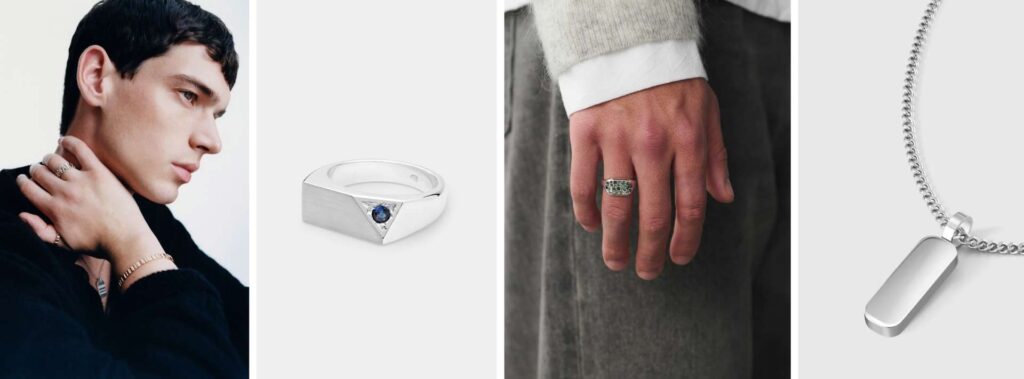
What Is Changing in Men’s Jewelry Design?
The opportunity for designers is broad because jewelry itself does not need to be restricted by gendered material categories. What changes commercially is how a product is designed, positioned, scaled and manufactured.
Several directions are particularly relevant for brands developing collections for 2027.
1. Sculptural Rings and Signets
Rings remain an important entry point into men’s jewelry, but the contemporary category extends beyond conventional signets.
Designers are experimenting with irregular surfaces, oversized proportions, engraved details, asymmetry and gemstones. Current men’s jewelry coverage includes everything from traditional signets to sculptural and embellished rings.
For manufacturers, those differences matter.
A relatively simple signet may require straightforward casting, engraving and polishing. A sculptural ring with a colored gemstone may require additional modeling, stone sourcing, setting and hand-finishing.
Deepwear’s research into unpolished gemstones explores how irregular stones can affect sourcing, batching and production planning. For designers interested in incorporating naturally varied stones into men’s rings or pendants, those same considerations can become part of the product-development process.
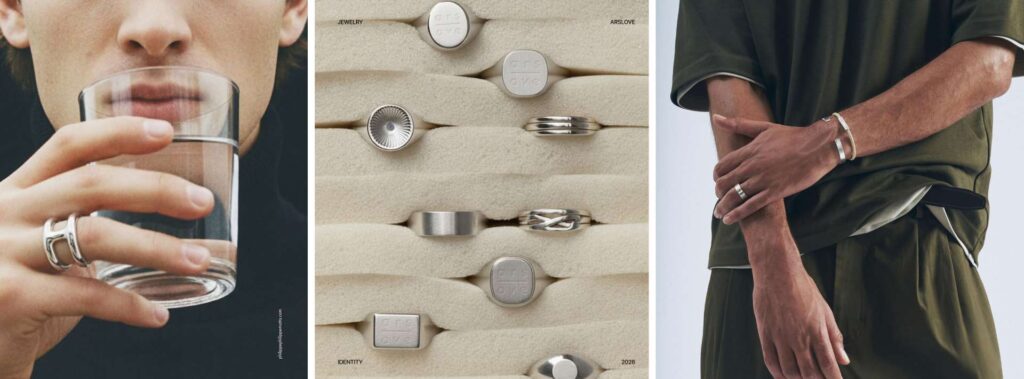
2. Gemstones and More Color
Men’s jewelry is also moving beyond a predominantly monochromatic palette.
Colored gemstones, diamonds and other stones can be used as focal points in rings, bracelets, earrings and pendants. Recent jewelry reporting has highlighted growing interest in oversized and colorful gemstone combinations, while men’s collections increasingly incorporate colored stones into traditionally restrained categories.
This is where sourcing strategy becomes particularly important.
A designer may know which stone they want visually, but production still depends on availability, dimensions, consistency, cutting, treatment, setting requirements and the number of pieces required. The more unusual the material, the more important it becomes to establish the sourcing route before committing to a production quantity.
For a deeper information, see Deepwear’s From Colored Gemstones to Production Strategy: Luxury Jewelry Manufacturing in 2026, which examines how material choice affects manufacturing strategy, supplier selection and MOQ planning.
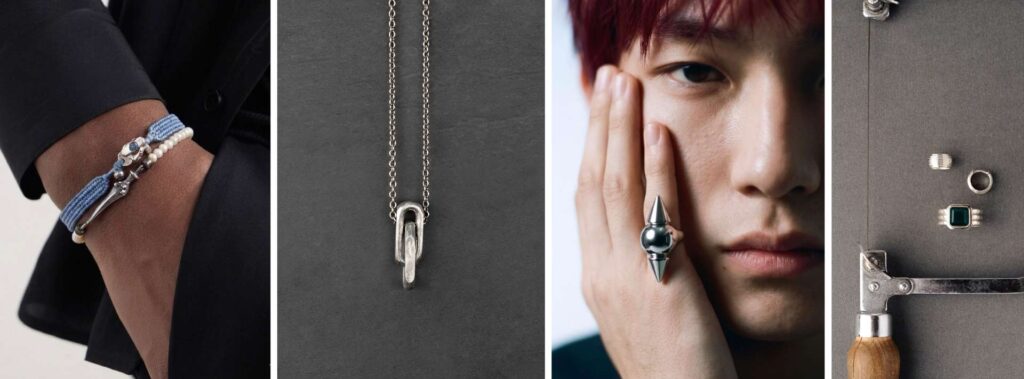
3. Pearls, Beads and Alternative Materials
Pearls are another example of how the boundaries around men’s jewelry are becoming less restrictive. Contemporary men’s collections now include pearl bracelets, necklaces and earrings alongside more traditional metals.
Beaded jewelry also offers considerable room for differentiation. Natural stones, glass, wood, shell and other beads can be combined with precious or non-precious metals, leather and cord.
For a brand, this can create an accessible way to experiment with materials without building an entire collection around precious metals.
It can also create more complicated production requirements.
Different components may come from different specialist suppliers. Beads may need to be matched by size and color. Metal components may require separate casting or finishing. Leather, cord or textile elements can introduce another production process altogether.
Deepwear’s work with alternative jewelry materials, including mussel-shell jewelry, demonstrates how material experimentation can require its own sourcing, prototyping and technical specifications.
Developing a jewelry collection with several materials or specialist components? Deepwear can help assess the capabilities required and coordinate suitable suppliers across our sourcing network. Start a conversation with our team.
4. Mixed Metals and More Expressive Finishes
Gold and silver are no longer necessarily separate design languages.
Mixed-metal jewelry, oxidized finishes, polished and matte surfaces, textured casting and contrasting components give designers more ways to create distinction within familiar products.
That can be particularly useful for brands entering men’s jewelry because differentiation does not always require an unusual material. It can come from the relationship between materials, proportions and finishing.
From a manufacturing perspective, the technical brief needs to be precise. The brand should establish the base metal, plating or coating requirements, surface finish, dimensions, stone specifications and intended wear conditions before sampling.
For brands working with sterling silver, Deepwear’s guide to 925 sterling silver meaning and other hallmarks explains why the metal specification and marking requirements should be established early in product development.
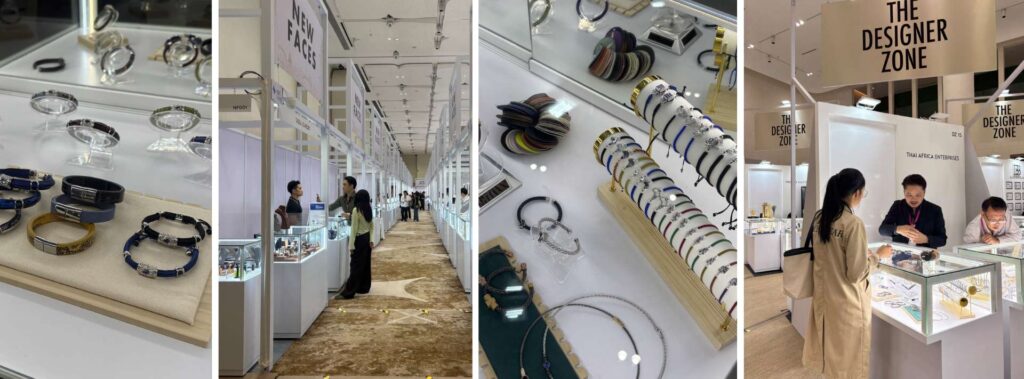
Choosing a Men’s Jewelry Manufacturer by Product
There is no single manufacturing country that is appropriate for every men’s jewelry collection.
A designer developing 50 sculptural gemstone rings may need a very different supplier from a brand producing several thousand plated fashion-jewelry pieces.
As Thoray d’Haese Sacoor, Deepwear’s founder and CEO, has demonstrated through decades of sourcing work, evaluating a supplier requires looking beyond its presentation and matching its actual capabilities to the product brief. Deepwear’s sourcing approach includes on-the-ground supplier assessment before manufacturers become part of its network.
For a men’s jewelry designer, that means starting with the product brief:
- What materials are required?
- Which manufacturing techniques are involved?
- How much variation can the design tolerate?
- What quantity is required for the first production run?
- Does the collection require specialist stone setting or hand-finishing?
- Is the product intended for luxury, premium, contemporary or accessible positioning?
- Will the collection need to scale after sampling?
These questions help narrow the manufacturing route before a brand begins requesting quotations.
The questions above are only a handful of what’s actually necessary to help you find your manufacturer. Book a consultation with our team to learn more.
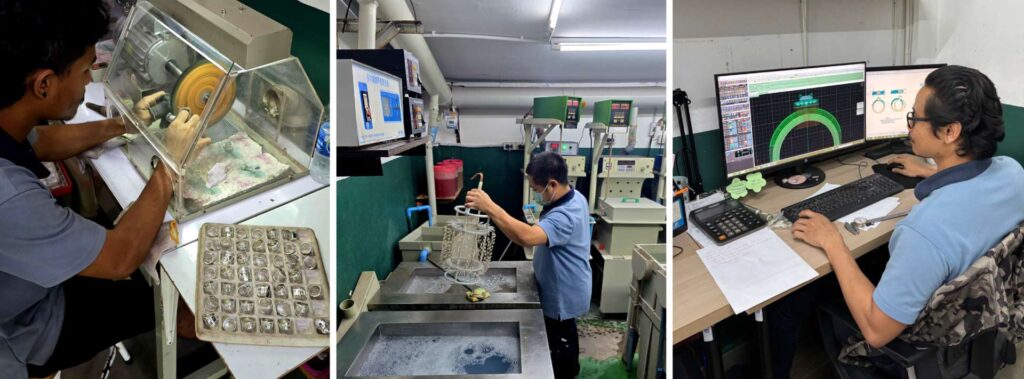
Key Sourcing Countries for Men’s Jewelry Manufacturing
Different jewelry-producing countries offer different combinations of craftsmanship, material access, production scale and finishing capabilities.
| Country | Jewelry manufacturing strengths | Potential applications |
| Thailand | Gemstones, sterling silver, stone setting, casting and artisanal production | Gemstone rings, silver jewelry, custom and small-batch collections |
| Italy | Fine jewelry, gold and silver production, precision craftsmanship and premium finishing | Luxury rings, sculptural jewelry and high-end collections |
| India | Gemstones, gold jewelry, silver jewelry and skilled handcrafted production | Gemstone-led, gold and artisanal collections |
| Turkey | Jewelry, silver, artisanal production and European-market proximity | Statement jewelry, silver collections and boutique production |
| Portugal | Premium European manufacturing and finishing | Contemporary and premium small-batch collections |
| Spain | Contemporary and fashion jewelry production | Fashion-led and smaller collections |
| China | Broad manufacturing infrastructure, OEM/ODM and production scale | Fashion jewelry, mixed materials and larger-volume programs |
These should be treated as production possibilities rather than fixed country rankings. The appropriate supplier depends on the exact design, material, quantity, price target and destination market.
Thailand
Thailand is particularly relevant when a collection depends on gemstones, silver, stone setting or handcrafted production.
Deepwear founder and CEO Thoray d’Haese Sacoor has long viewed sourcing markets through the lens of manufacturing capability rather than simply unit cost. For jewelry brands, that distinction matters. A supplier’s ability to work with gemstones, develop samples, handle finishing and communicate with an international brand can be more important than finding the lowest initial quotation.
Thailand’s established gems and jewelry ecosystem gives designers access to a combination of gemstone expertise, silver production, setting, casting and finishing.
Deepwear’s Bangkok team provides an on-the-ground point of contact when brands are evaluating suppliers and production possibilities. Our existing guides to Thailand’s jewelry manufacturing industry and Thailand’s jewelry districts go deeper into the country’s production ecosystem.
Italy
Italy is particularly relevant for brands looking for premium jewelry manufacturing and high-end finishing.
The Italian jewelry industry includes established production clusters such as Vicenza, Valenza, Florence and Arezzo, with capabilities spanning goldsmithing, silverware and fine jewelry.
Italy can therefore make sense for collections where craftsmanship, finishing and European production are central to the product brief.
Deepwear’s Italy team can help brands explore manufacturing possibilities within the country’s established production network.
India
India offers substantial depth across gemstones, gold, silver and jewelry manufacturing.
Major production and trading hubs include Surat, Mumbai and Jaipur, creating a broad ecosystem for gemstone processing, jewelry manufacturing and export.
For men’s jewelry designers, India can be particularly relevant when a collection relies heavily on gemstones, gold, handcrafted construction or significant production depth.
Deepwear’s India team can help brands investigate suppliers and manufacturing options according to the requirements of the collection.
Turkey
Turkey offers another route for brands looking for jewelry production, particularly when European proximity and flexible manufacturing are important.
Deepwear’s Istanbul team works close to the country’s established jewelry and accessories market. Our local presence can help brands assess suppliers, compare production possibilities and coordinate manufacturing according to product requirements.
Portugal and Spain
Portugal and Spain can be relevant for brands seeking European production, contemporary jewelry development and smaller-scale or premium programs.
For European brands, these markets can also offer geographical proximity that becomes important when sampling, communication, factory visits and replenishment need to be managed within Europe.
Deepwear’s European teams can help connect a product brief with appropriate manufacturing options rather than assuming that every component needs to come from one country.
China
China remains important for brands requiring broader manufacturing infrastructure, OEM/ODM capabilities, components or greater production scale.
For men’s jewelry, this can be particularly relevant to fashion-jewelry collections, mixed-material products and designs that require multiple components or larger production quantities.
Deepwear’s Guangzhou team gives us an on-the-ground connection to the Chinese manufacturing market, allowing brands to compare suppliers according to product specifications, quantity and commercial requirements.
A gemstone-heavy collection, a fashion-jewelry range and a luxury gold collection may each require different supplier profiles. Deepwear’s role is to help brands evaluate those differences and connect the product brief with appropriate manufacturing partners.
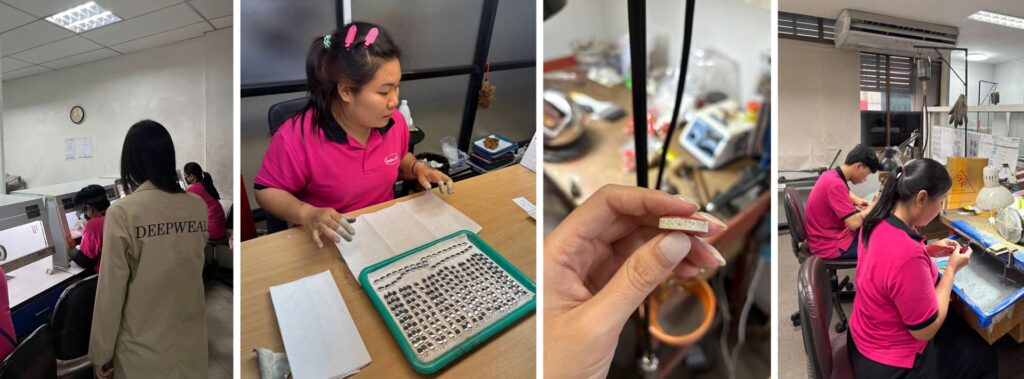
From Men’s Jewelry Concept to Production
The expansion of men’s jewelry creates space for more than additional versions of conventional chains and watches.
Designers are working with gemstones, pearls, beads, sculptural metals, mixed finishes and alternative materials to create products with their own visual language. For brands, the manufacturing challenge is making those ideas practical at the required quality, quantity and price.
This is where Thoray d’Haese Sacoor’s approach to sourcing continues to shape Deepwear’s work: start with the product and its requirements, then determine which manufacturing market, supplier and production structure make sense.
That can mean working with a gemstone specialist in Thailand, evaluating fine-jewelry capabilities in Italy, exploring production in India, or coordinating different suppliers when one manufacturer cannot provide every required capability. Deepwear’s international teams give brands access to local knowledge across key sourcing markets while keeping the overall production strategy connected.
Developing a men’s jewelry collection for 2027? Contact Deepwear to discuss your sourcing, manufacturing and production requirements.