
Explore sustainable jewelry upcycling, from discarded mussel shells and biomaterial processing to luxury design, sourcing, manufacturing, and quality assurance.
In the global jewelry industry, sustainable material innovation is creating new possibilities for brands looking beyond conventional precious metals and gemstones. Mussel shell upcycling is one emerging approach, transforming discarded shell material into components for jewelry, accessories, and decorative applications.
Mussel shells are a significant byproduct of seafood harvesting and aquaculture. Globally, mollusk shells from oysters, clams, scallops, and mussels are estimated to generate more than 10 million tons of waste annually.
In this blog, we cover:
- How mussel shell waste can be processed into jewelry materials
- Technical considerations for shell-based composites and inlays
- Key sourcing countries for sustainable jewelry manufacturing
- Material, finishing, and quality assurance considerations
- How Deepwear can support brands developing specialized jewelry products
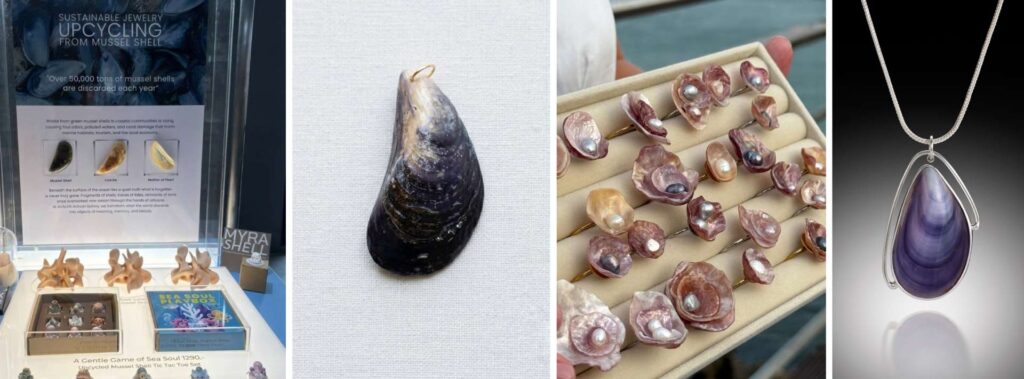
The Global Opportunity in Mussel Shell Waste
Mussel shells are a substantial byproduct of seafood harvesting and aquaculture. When discarded without appropriate waste management, shells containing residual organic matter can create odor and disposal problems. Research on seashell waste has identified unpleasant odors from decomposing organic material as one of the challenges associated with conventional disposal.
At the same time, the shells themselves contain valuable mineral material that can be repurposed.
Calcium carbonate is the primary mineral component found in many seashells, including mussels. A review of bio-calcium carbonate from eggshell and seashell waste reports calcium carbonate contents of approximately 92–99% across various seashell types, while a study of mussel shell waste describes the material as a rich source of calcium carbonate.
Research in Thailand has specifically investigated mussel shell waste as a potential source of bio-calcium carbonate and calcium oxide. One study found that Thai mussel shell waste could be processed and calcined into a calcium-rich material, while subsequent research has explored mechanically processed mussel-shell calcium carbonate for other applications.
For jewelry brands, the opportunity lies in taking this waste stream and developing it into a controlled material with a consistent appearance and suitable performance.
Shell material can be cleaned, dried, milled, shaped, polished, and combined with other materials depending on the intended application. In some applications, shell particles can function as a mineral filler within a resin-based composite. Larger shell pieces can also be used for decorative inlays or carved components.
This makes mussel shell upcycling particularly relevant to brands interested in sustainable jewelry manufacturing, material storytelling, and product development.
For a broader introduction to how recycled and repurposed materials can be incorporated into jewelry, see Introduction to Sustainable Jewelry, where we explore recycled precious metals, repurposed materials, ethical sourcing, and other approaches to more responsible jewelry production.
Developing a jewelry collection around an upcycled material? Our team can help you explore suitable materials, manufacturers, and production options based on your product requirements. Talk to Deepwear about your sustainable jewelry project.
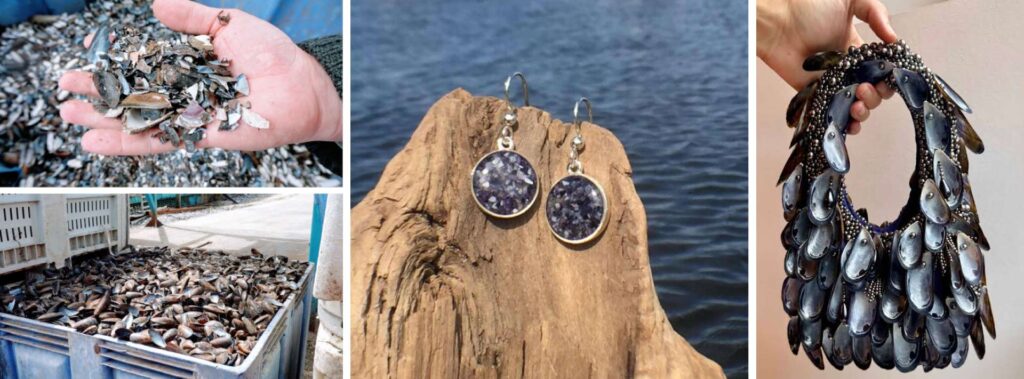
How Mussel Shells Are Processed for Jewelry
The processing method depends on whether the finished component uses shell powder, larger shell fragments, or the shell’s decorative inner surface.
Step 1: Sourcing and Cleaning
Discarded shells first need to be collected and cleaned to remove remaining organic material, salts, dirt, and other contaminants. Thorough drying is also important before further processing.
For manufacturers, this stage is important because inconsistent cleaning or moisture content can affect subsequent processing and composite formation.
Step 2: Milling and Particle Preparation
Cleaned shells can be mechanically milled into powder or smaller particles. Particle size is selected according to the intended application, manufacturing method, surface finish, and desired properties.
For jewelry development, brands should therefore establish the required particle size with the manufacturer based on the resin system, molding process, surface finish, and final product requirements rather than applying one fixed mesh range.
Finer particles can provide a more uniform appearance in some composite applications, while larger particles can create visible texture and variation.
Step 3: Mother-of-Pearl and Decorative Surface Processing
The inner surface of some shells can provide an iridescent, nacre-like appearance that is particularly attractive for jewelry and decorative applications.
Depending on the component, manufacturers may cut, abrade, polish, engrave, or machine shell pieces into specific shapes. CNC machining and other precision techniques can be used where repeatable dimensions are required.
The result can range from subtle shell inlays to statement components where the natural variation of the material becomes part of the design.
Step 4: Composite Formation
Milled shell particles can also be incorporated into polymer or resin systems to create composite materials.The appropriate formulation depends on the particle size, binder chemistry, molding method, curing conditions, and required mechanical and aesthetic properties. Manufacturers should therefore establish the formulation through material testing and prototype development.
Manufacturers may use bio-based or conventional polymer systems depending on the product specification. Mixing, degassing, molding, curing, and finishing all influence the final appearance and performance of the material.
For brands, this means that a shell-based composite should be treated as a developed material specification rather than simply a decorative waste product. The manufacturer should be able to provide information on the material composition, production process, finish, and relevant testing.
Brands interested in developing products from other recovered materials can also explore Working With Recycled Materials for Fashion Brands, which examines practical considerations around sourcing, processing, supplier capabilities, and commercial development of recycled materials.
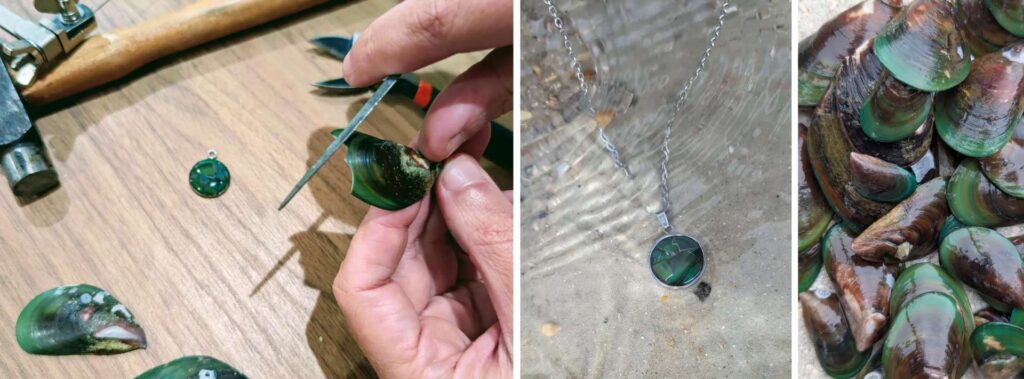
Where Can Brands Source Mussel Shell Jewelry Manufacturing?
Different jewelry-producing countries offer different combinations of craftsmanship, machinery, material expertise, finishing capabilities, and production scale. The right sourcing destination therefore depends on the product rather than a single country being universally best.
For more information on supplier selection, production capabilities, ethical standards, sampling, and sourcing requirements, see How to Choose Jewelry Manufacturers That Match Your Brand’s Quality and Ethics.
1. Thailand
Thailand has a strong jewelry manufacturing ecosystem covering silver jewelry, gemstone work, casting, plating, polishing, and specialized finishing. Thailand is also particularly relevant to this material discussion because scientific research has documented substantial mussel shell waste from the country’s seafood industry.
For Deepwear, Thailand is more than a sourcing destination on a country list. Our Bangkok team is on the ground and can work directly with local manufacturers, suppliers, workshops, and material specialists to investigate whether a proposed mussel shell project is commercially and technically viable. This local presence gives us a practical way to assess what materials are actually available, how they are being processed, and which manufacturers have the capabilities needed for the finished product.
For brands developing shell-based jewelry, Thailand can therefore provide an interesting combination of jewelry manufacturing expertise and access to a regional ecosystem where mussel shell waste is already being investigated as a usable biomaterial.
Our team can also help brands move beyond a material claim on paper by checking supplier capabilities, discussing the origin and preparation of shell material, reviewing samples, and comparing available production routes. Where a project requires specialized casting, plating, polishing, silver production, or shell-based components, we can coordinate with manufacturers on the ground and assess whether their capabilities match the actual product specification.
2. Italy
Italy remains an important sourcing destination for brands seeking high-end jewelry development, particularly around established manufacturing centers such as Vicenza and Arezzo. Italian manufacturers can be relevant for premium jewelry where finishing, craftsmanship, material presentation, and detailed production specifications are central to the product.
For plated pieces, brands should specify the required gold purity, plating thickness, base material, and destination-market requirements rather than relying on a generic description such as “gold plated.”
Deepwear’s local presence in Italy allows our team to assess manufacturers and production options directly rather than relying solely on remote supplier information. For a luxury shell-based jewelry project, this can be particularly useful when the material needs to be combined with high-quality metalwork, detailed finishing, or specialized craftsmanship.
Our team can communicate with manufacturers in the local production environment, review samples and capabilities, and help determine whether an Italian supplier is genuinely suited to the required specification, production volume, finishing standard, and commercial positioning. This is especially valuable when a brand wants to understand the difference between a supplier’s stated capabilities and what can actually be delivered in production.
3. China
China offers extensive jewelry manufacturing capabilities, including CNC machining, casting, molding, plating, prototyping, and large-scale production.
This combination can be useful when brands are developing new shell-based materials that require prototyping before production. Manufacturers can test different particle sizes, shapes, finishes, and composite formulations before moving into larger quantities.
China can therefore be particularly useful for brands looking to balance material experimentation with scalable manufacturing.
Deepwear’s local China team can help brands investigate these capabilities directly, including identifying manufacturers with the machinery and production experience relevant to a particular shell-based design. Rather than selecting a supplier solely from an online capability list, our team can communicate with manufacturers, review their processes and samples, and assess whether their equipment and production setup are appropriate for the project.
This on-the-ground approach is particularly relevant for experimental materials. A supplier may be capable of CNC machining or resin molding in general, for example, while having limited experience working with shell-derived particles or a particular composite formulation. Our team can help brands investigate those practical differences before committing to production.
4. India
India has long-established jewelry and gemstone manufacturing capabilities, with specialist centers such as Jaipur offering expertise in cutting, carving, silver jewelry, and decorative stonework.
These capabilities can complement shell-based jewelry development where the product combines shell with metal, carved elements, gemstones, or detailed decorative work.
With Deepwear’s local teams and sourcing network in India, brands can also investigate manufacturers based on their actual production capabilities, rather than treating India as a generic jewelry sourcing market. Our team can communicate directly with suppliers, review manufacturing options, and assess whether a workshop’s skills and equipment align with the proposed shell component, metal construction, finishing, and production volume.
For projects combining mussel shell with silver, carved components, gemstones, or intricate decorative work, this local assessment can help identify the most appropriate production route and determine where different stages of development should take place.
Looking for the right country to manufacture your jewelry? Deepwear’s local teams can help you compare manufacturers and production capabilities on the ground, from material development and prototyping to finishing and larger-scale production. Contact our team to discuss your sourcing requirements.
Technical Guidelines for Shell-Based Jewelry
Sustainable material development still requires the same level of product specification as conventional jewelry.
Brands should define:
- Base metals: recycled 925 sterling silver, recycled brass, stainless steel, or another specified material
- Shell material: powder, fragments, inlay, or carved shell
- Binder: specific resin or polymer system where applicable
- Surface finish: polished, matte, textured, coated, or plated
- Color: natural shell variation or standardized coloration
- Plating: metal type, purity, thickness, and finish
- Wear requirements: water, sweat, abrasion, UV, and environmental exposure
- Destination-market requirements: applicable material, labeling, and chemical compliance standards
These considerations are particularly important when a sustainable material is combined with a specific metal specification. Our guide Sourcing Authentic Sterling Silver: Guide for Jewelry Manufacturers covers material verification, sourcing considerations, and the importance of confirming the composition of sterling silver used in production.
Testing may include adhesion, surface durability, dimensional stability, salt-spray exposure, and other tests appropriate to the finished product.
For a broader look at how these checks fit into jewelry production, Quality Assurance in Jewelry Manufacturing: Deepwear Approach covers raw-material inspection, design and production review, in-process checks, final inspection, and laboratory testing.
This is where quality assurance in jewelry manufacturing becomes particularly important. Raw materials should be checked against specifications, prototypes should be evaluated before production, and finished pieces should be inspected for consistency, surface defects, dimensions, plating, and construction.
For metal components, brands may also require material verification such as XRF testing or other laboratory analysis, depending on the specification and destination market.
Sustainable Sourcing Requires Evidence
Using a waste material does not automatically make a finished jewelry product sustainable.
Brands should ask where the shell material originates, how it is collected, how it is cleaned and processed, what other materials are introduced during production, and what documentation is available.
This is particularly important when sustainability claims form part of a product’s marketing.
As we discuss in Greenwashing in the Jewelry Industry: The Importance of Ethical Sourcing and Transparency, sustainability claims should be supported by evidence, documentation, and transparency rather than broad environmental language. This is particularly relevant when a jewelry collection is marketed around an upcycled material.
Brands should also distinguish between a material being recycled, reclaimed, upcycled, or simply containing a small percentage of waste-derived material. The terminology should accurately reflect the manufacturing process.
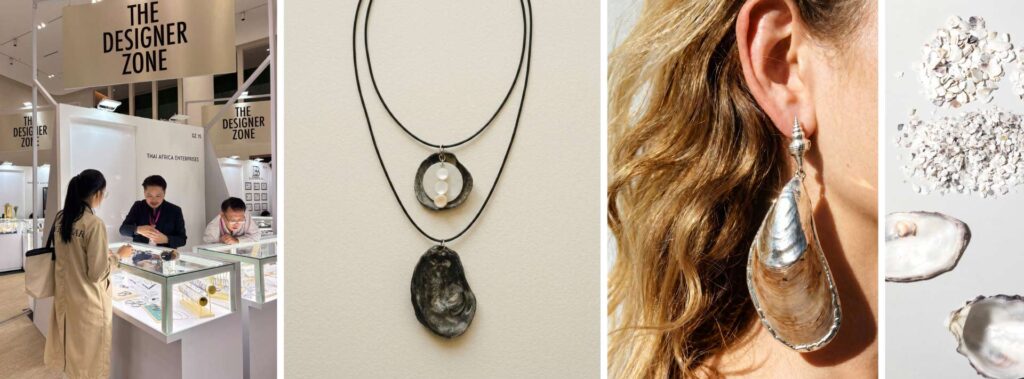
How Deepwear Can Support Mussel Shell Jewelry Development
At Deepwear, we approach specialized jewelry sourcing by connecting brands with manufacturers and suppliers that match their product requirements.
Our network across Thailand, Italy, China, India, and other jewelry-producing markets gives brands access to different manufacturing capabilities depending on the design, material, finishing, quantity, and target price.
For a mussel shell jewelry project, our team can support the process from manufacturer identification and material discussions through sampling, production coordination, and quality assurance.
That can include evaluating whether a manufacturer has the equipment required for shell processing, composite development, CNC work, casting, plating, polishing, or other techniques needed for the final design.
Rather than treating sustainable material sourcing as a standalone purchasing decision, we can help brands connect the material specification with the actual manufacturing process.
Is mussel shell jewelry sustainable?
Mussel shell jewelry can be a sustainable material option when discarded shells are recovered and processed into new jewelry components, reducing reliance on newly sourced materials. However, the sustainability of the finished product also depends on how the shells are collected, processed, combined with other materials, manufactured, and documented. Brands should verify the origin and processing of the shell material and avoid making broader environmental claims that cannot be supported by evidence.
Building Luxury Jewelry From Waste Materials
Mussel shell upcycling demonstrates how waste streams can become starting points for new material development.
The strongest opportunity for brands is not simply to market mussel shell as a “sustainable” material. It is to understand the material technically, document its origin and composition, develop a repeatable manufacturing process, and communicate its environmental attributes accurately.
With appropriate processing and manufacturing expertise, discarded shells can become powders, composites, inlays, and decorative components for jewelry and accessories.
The final product still depends on careful sourcing, material development, skilled manufacturing, and quality assurance. For brands willing to invest in that process, mussel shell upcycling offers another route toward distinctive jewelry designs that incorporate recovered materials into a commercially viable product.
Are you developing a jewelry collection using mussel shells or another upcycled material? Contact our team to explore suitable manufacturers, material options, and production routes for your product.