
Discover how brands can source Moroccan carpets, rugs, and kilims, from traditional handwoven production and artisan workshops to materials, quality assurance, MOQs, and international sourcing.
Moroccan carpets have moved well beyond traditional souks and residential interiors. For international fashion, lifestyle, hospitality, and home brands, Moroccan carpet manufacturing offers access to distinctive handwoven products shaped by regional materials, weaving techniques, and artisan expertise.
UN COMTRADE data reported by Trading Economics put Morocco’s exports of carpets and other textile floor coverings at US$41.79 million in 2025. The broader export category includes different forms of textile floor coverings, so the figure should not be interpreted as representing only traditional Moroccan handmade rugs. For brands sourcing specifically Moroccan carpets, rugs, and kilims, product-level trade classifications provide a narrower view of individual categories.
For brands, the opportunity comes with a sourcing consideration: Moroccan carpets can come from very different production environments. A project may involve an artisan working through a family-run workshop, a specialist weaving operation, or a more structured manufacturing partner. Understanding those differences is important when developing a product for international production.
In this blog, we cover:
- Types of Moroccan carpets and rugs
- How Moroccan carpets are made
- Artisan workshops vs. conventional manufacturing
- MOQ and production considerations
- Quality assurance and sourcing considerations
Why Source Moroccan Carpets?
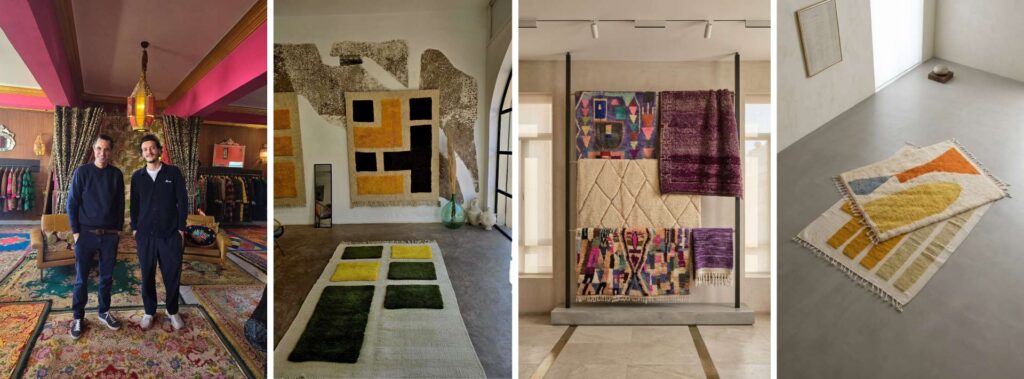
Moroccan carpet production combines regional craftsmanship with a diverse supply base. Traditional weaving communities across areas such as the Middle Atlas and High Atlas have developed distinctive approaches to wool preparation, weaving, knotting, pattern development, and finishing.
Deepwear has previously explored Morocco’s broader handicraft ecosystem, including its handwoven wool rugs and traditional textile production. The country’s artisan sector provides opportunities for brands seeking products with a strong material and cultural identity.
The commercial scale of the category also matters. Maison de l’Artisan identifies carpets as one of Morocco’s major handicraft export categories, while its recent monitoring found continued international interest in Moroccan carpets, with design among the most frequently cited purchase considerations.
For a brand, sourcing from Morocco can therefore combine:
- Traditional handcraft techniques
- Wool and other textile materials
- Custom designs and dimensions
- Small-scale artisan production
- Larger production partnerships where available
- Access to established international export markets
The right production model depends on what the brand is trying to make.
Types of Moroccan Carpets Brands Can Source
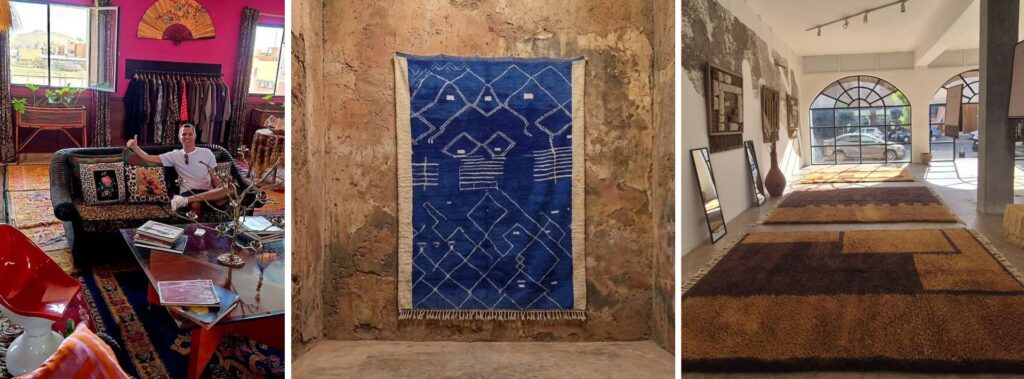
There is no single Moroccan carpet style. Different regions and production communities are associated with different construction methods, materials, patterns, and visual characteristics.
1. Beni Ourain Rugs
Beni Ourain rugs are traditionally associated with the Middle Atlas and are known for their wool construction, high pile, neutral backgrounds, and geometric motifs.
Their relatively minimal visual language has made them particularly relevant to contemporary interiors and premium lifestyle collections.
For commercial production, brands should specify more than a visual reference. Wool composition, pile characteristics, dimensions, pattern placement, and finishing should be established during product development.
2. Azilal Rugs
Azilal rugs originate from the High Atlas region and are commonly associated with expressive geometric and abstract designs.
Compared with more restrained neutral styles, Azilal-inspired products can offer stronger color and pattern variation. This can make them suitable for statement interiors and design-led collections.
Because handmade production can create natural variation, brands should establish acceptable tolerances for color, dimensions, pattern placement, and workmanship before production begins.
3. Boujad Rugs
Boujad rugs are associated with central Morocco and are often recognized for warmer color palettes, geometric motifs, and more expressive compositions.
For brands, the appeal can lie in adapting these visual characteristics into contemporary color palettes or custom dimensions while retaining the handmade character of the product.
4. Boucherouite Rugs
Boucherouite rugs are distinctive because they can incorporate textile remnants and other reclaimed materials into colorful woven designs.
Their irregular appearance can be part of the product’s aesthetic rather than a manufacturing defect. Brands developing this category should therefore establish clear material and appearance specifications while allowing reasonable variation inherent to the production method.
5. Moroccan Kilim
Moroccan kilims are flatwoven rather than constructed with a thick pile. This creates a lighter textile with a different surface, structure, and application.
For lifestyle brands, Moroccan kilim production can be relevant to rugs, wall textiles, decorative pieces, and other interior applications where a flatter construction is preferred.
Other Regional Styles
Morocco also has other regional carpet and weaving traditions, including products associated with areas such as Taznakht, the Middle Atlas, and southeastern Morocco.
The important sourcing consideration is that regional names should not be treated as interchangeable product specifications. Brands should identify the actual construction, material, dimensions, design requirements, and production method they need.
For more on Morocco’s regional production network, see Tangier vs Casablanca: Choosing the Right Moroccan Manufacturing Hub for Your Garment Category.
How Are Moroccan Carpets Made?
The production process varies according to the carpet type, workshop, materials, and construction method.
A traditional handwoven carpet may involve several stages that can affect the final product.
- Material Preparation
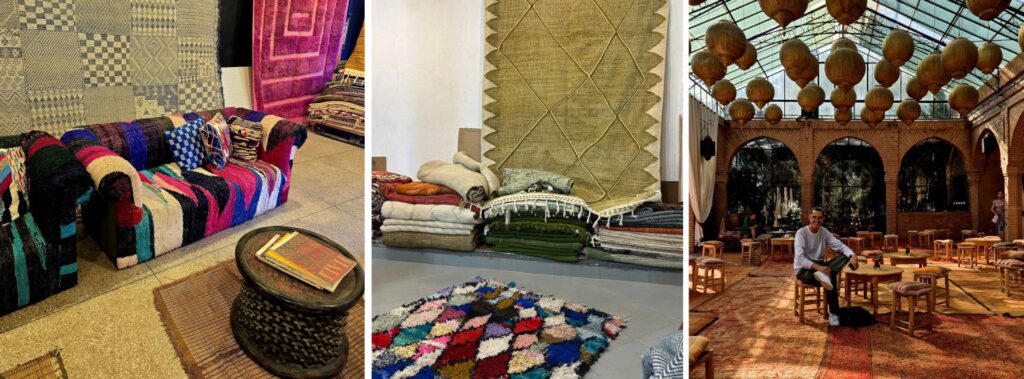
Wool is an important material in Moroccan carpet production, particularly for traditional handwoven rugs. Brands developing commercial products should establish the required fibre composition and material characteristics before sampling.
If a project requires a particular wool specification, recycled fibre, cotton component, or another material, this should be included in the product brief rather than left to interpretation.
2. Spinning and Yarn Preparation
The yarn affects the texture, weight, appearance, and durability of the finished carpet.
For a commercial collection, brands may need to define:
- Fibre composition
- Yarn characteristics
- Thickness
- Color
- Spinning requirements
- Required consistency between production batches
3. Dyeing
Color requirements can be particularly important for custom carpet production.
Brands should provide appropriate color references and establish acceptable tolerances before production. Natural variation may occur in handmade dyeing processes, so the expected level of variation should be agreed during sampling.
4. Weaving or Knotting
This is where production methods differ significantly.
Hand-knotted carpets are constructed by tying individual knots around the warp, while flatwoven carpets and kilims use weaving techniques without the same raised pile structure.
Construction affects:
- Weight
- Thickness
- Texture
- Production time
- Durability
- Appearance
- Cost
A brand should therefore specify the construction method rather than simply supplying an image of the desired finished product.
5. Finishing
Finishing can include trimming, washing, drying, fringe preparation, cleaning, and other treatments required for the finished product.
The appropriate process depends on the carpet construction and final use.
How Deepwear Supports Moroccan Carpet Sourcing
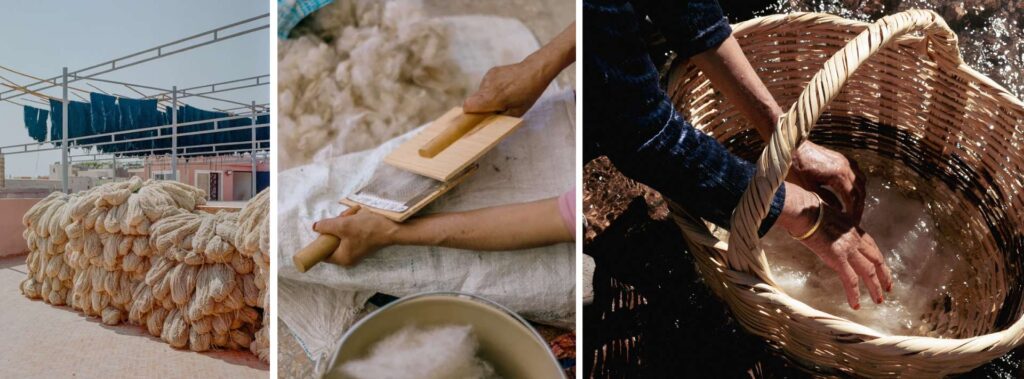
Sourcing Moroccan carpets requires finding the right production partner for the product, quantity, construction, and destination market. Morocco’s carpet sector includes established manufacturers as well as artisan workshops and family-run suppliers, making the sourcing approach highly dependent on the project.
Deepwear’s Morocco team connects international brands with Moroccan carpet suppliers, manufacturers, workshops, and artisans, helping brands identify suitable production partners and coordinate development through shipment.
Product Specifications
A clear specification gives suppliers a consistent basis for sampling and pricing. For Moroccan rugs and kilims, brands should establish the key requirements before development, including:
- Dimensions and construction: finished size, tolerances, pile height, weave or knotting method
- Materials and design: fibre and yarn composition, colors, patterns, fringe, and backing
- Finishing and delivery: finishing requirements, intended use, packaging, labelling, quantity, and destination market
Two carpets can look similar in photographs while differing significantly in construction, density, materials, and finishing. Defining these details early makes supplier comparisons more meaningful.
Quality Assurance
Handmade production requires product-specific quality assurance. Variations in color, texture, pattern, or dimensions can be inherent to handwoven production, while structural defects or deviations from approved specifications still need to be identified.
Depending on the product, checks can cover materials, construction, dimensions, appearance, finishing, quantity, and packaging. The appropriate tolerances should be established against the approved sample and product specifications rather than applying identical standards to every handmade carpet.
Finding the Right Moroccan Supplier
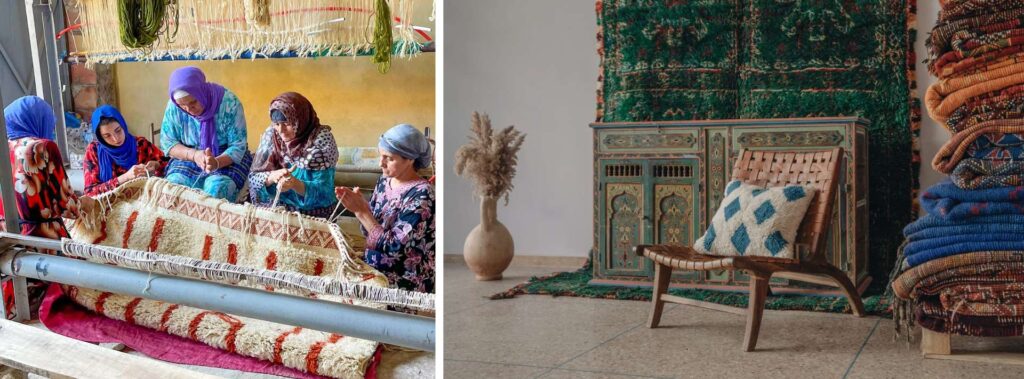
The right production model depends on the collection. An artisan workshop may be appropriate for a limited series of highly customized pieces, while a more structured Moroccan carpet manufacturer may be better suited to larger or repeatable programs.
Deepwear can support supplier identification, product development, sampling, material sourcing, production coordination, quality assurance, packaging, and logistics. Our team helps brands navigate Morocco’s diverse production network and connect their requirements with suitable local capabilities.
Looking to source Moroccan carpets, rugs, or kilims? Contact our team to discuss your specifications and explore suitable production options in Morocco.
Artisan Workshops vs. Conventional Carpet Manufacturing
One of the most important considerations when sourcing Moroccan carpets is understanding the difference between artisan production and conventional manufacturing.
Morocco’s handicraft ecosystem includes small workshops and artisan producers alongside more structured production operations. Deepwear’s broader experience with handmade products also highlights an important practical consideration: artisans accustomed to traditional production may not operate according to the same processes as a high-volume factory.
| Factor | Artisan production | More structured manufacturing |
| Production scale | Small to medium | Medium to larger |
| Customization | Often highly flexible | Depends on supplier capabilities |
| Design variation | Can be significant | Generally easier to standardize |
| Production capacity | More limited | Usually higher |
| MOQ | Project-dependent | More likely to have defined requirements |
| Lead time | Can vary | Generally easier to plan |
| Craftsmanship | Highly specialized | Can combine skilled labour with standardized processes |
| Quality specifications | Must be clearly communicated | More standardized systems may be available |
Neither model is automatically better.
The appropriate choice depends on the brand’s required quantity, design, timeline, budget, construction method, and acceptable variation.
Moroccan Carpet MOQ: What Should Brands Expect?
There is no universal MOQ for Moroccan carpets.
A supplier’s minimum order may depend on:
- Carpet dimensions
- Construction method
- Wool or fibre specification
- Existing vs. custom design
- Color customization
- Production capacity
- Private-label requirements
- Packaging
- Repeat-order expectations
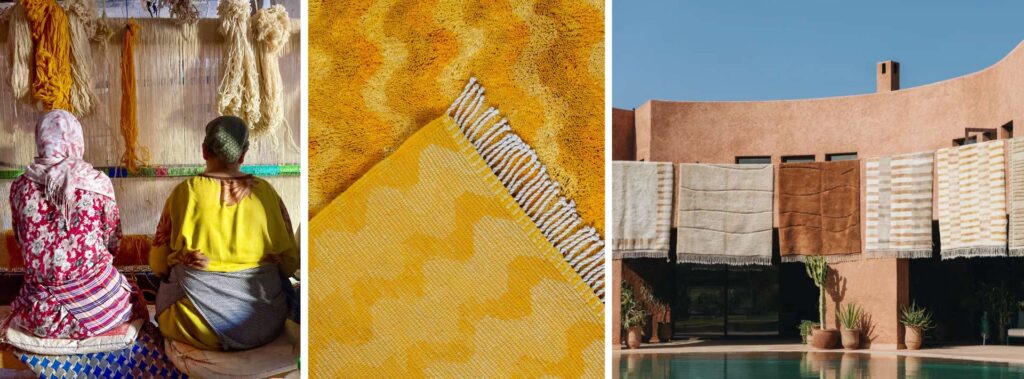
An artisan workshop may be able to produce a very small number of highly customized pieces, while another supplier may require a larger production run to make a project commercially viable.
For this reason, brands should treat MOQ as a supplier- and project-specific figure, rather than assuming that every Moroccan carpet manufacturer operates under the same minimum.
MOQ Disclaimer: MOQ ranges for Moroccan carpets vary according to the supplier, construction method, dimensions, materials, customization, and production capacity. Any MOQ discussed during sourcing should be treated as indicative until confirmed directly with the selected supplier.
Moroccan Carpets for International Brands
Whether you are developing handwoven Moroccan rugs, kilims, or a larger commercial carpet collection, finding the right production partner is an important part of the process. Deepwear can help you identify suitable Moroccan carpet suppliers, coordinate product development, and manage sourcing and production from specification to shipment.