
Discover how Deepwear sources and develops intricate hair accessories, from Chinese hairpins and Japanese kanzashi to jewelry-led designs, across global manufacturing markets.
Intricate hair accessories are moving beyond their role as occasional styling pieces. From elaborate Chinese hairpins appearing in micro-dramas to Japanese kanzashi, Korean binyeo and Indian hair jewelry, traditions around the world show how a functional object can become a highly crafted piece of adornment.
For fashion brands, this creates an interesting product opportunity for 2027: developing hair accessories with the construction, material quality and visual detail usually associated with jewelry.
In this blog, we cover:
- Why ornate hair accessories are gaining renewed attention
- What global hair-ornament traditions can teach modern brands
- Manufacturing countries for different hair accessory requirements
- How sourcing, sampling and production affect intricate designs
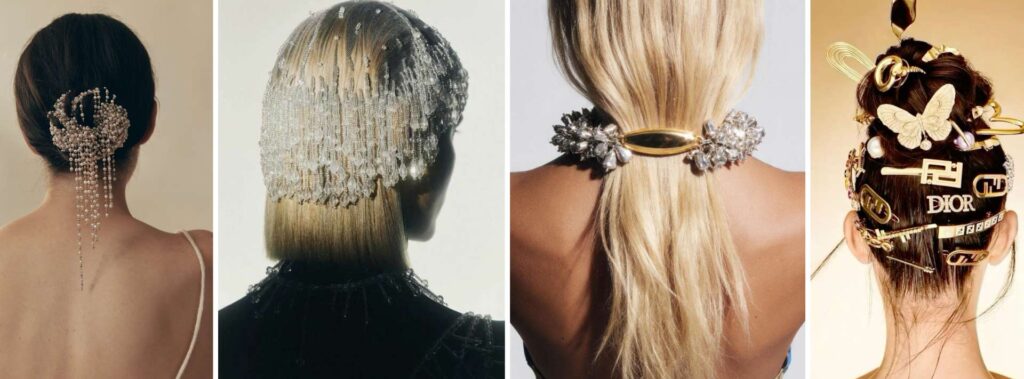
Why intricate hair accessories are back in focus
Chinese micro-dramas have become a global digital phenomenon, bringing highly stylized historical and fantasy costumes to audiences far beyond China. Their vertical format places particular emphasis on immediately recognizable visual details, including hairstyles and accessories. Chinese short dramas have also expanded internationally, making their visual language increasingly familiar to audiences outside China.
That visibility has helped put Chinese hairpins, including elaborate zan, chai and buyao-inspired designs, back into the international fashion conversation.
The underlying idea, however, is much broader than Chinese costume culture.
Across different societies, hair has provided a canvas for craftsmanship. Hairpins, combs, crowns, braid ornaments and jeweled headpieces have been used to secure hairstyles, mark occasions, express status and incorporate materials ranging from silk and wood to precious metals and gemstones.
For contemporary brands, the opportunity lies in translating that craft-led approach to adornment into products that work with modern wardrobes.
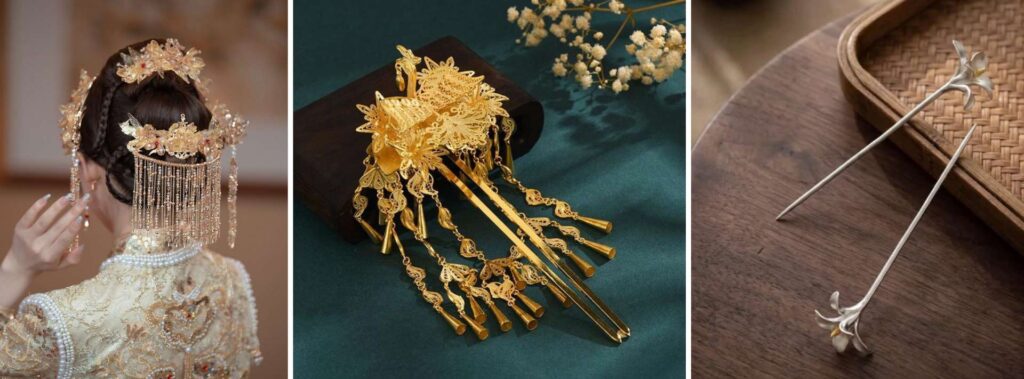
From Chinese hairpins to a global language of hair jewelry
Chinese zan and chai demonstrate different approaches to securing hair, while the buyao adds movement through suspended decorative elements.
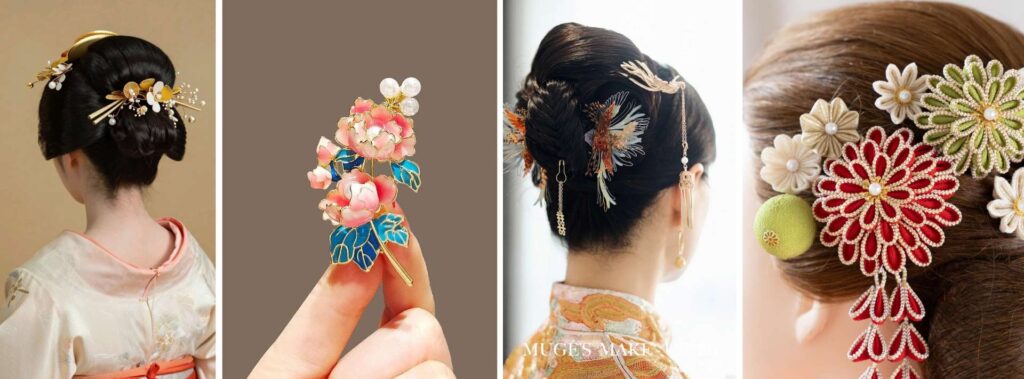
Japan’s kanzashi offers a different design language. Edo Tsumami-Kanzashi uses tiny pieces of silk that are cut, folded and assembled into flowers, birds and other motifs. Tokyo’s traditional craft authorities identify Taito, Sumida and Arakawa as principal production areas for the craft.
Kanzashi also demonstrates how a traditional accessory can communicate seasonality. Floral motifs and designs can change according to the occasion and time of year, turning the accessory itself into part of the visual story.
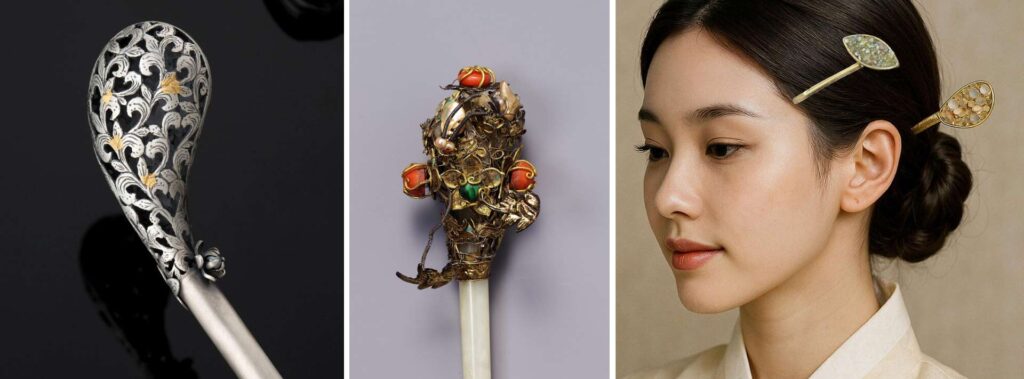
Korean hairpins provide another example. Traditional binyeo and related ornaments could combine structural function with materials such as silver, jade and other decorative elements. Their forms and materials also carried social and cultural associations.
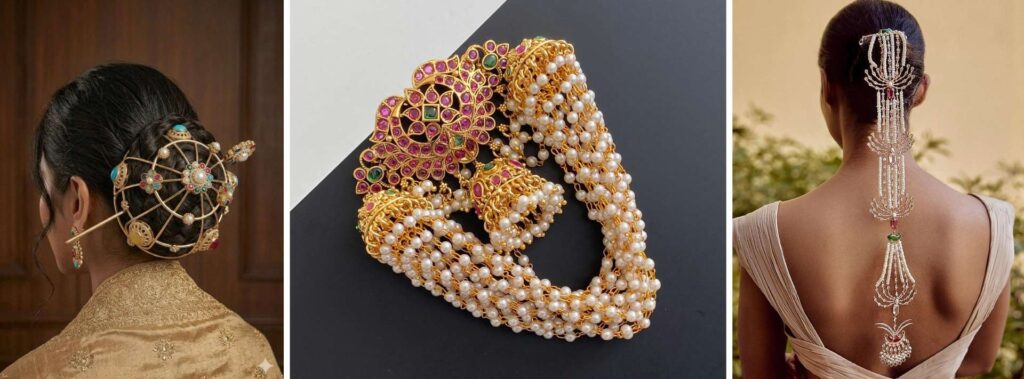
In India, hair ornamentation has often moved even closer to jewelry. Head and braid ornaments can incorporate metalwork, gemstones, pearls and repeated sculptural elements, creating pieces that function as both hair adornment and jewelry.
These traditions should not be treated as interchangeable sources of aesthetic motifs. Their histories and cultural contexts differ. Their shared lesson is more useful: hair accessories can be developed as serious objects of craftsmanship rather than disposable additions to an outfit.
A sourcing question worth asking
If your concept takes inspiration from a specific traditional accessory, the first manufacturing question should be which technique you actually need, rather than which country happens to be associated with the aesthetic.
Deepwear’s guide, How to Choose Jewelry Manufacturers That Match Your Brand’s Quality and Ethics, looks at manufacturer selection through capabilities, sampling, materials, finishing and supplier evaluation. Those same considerations apply when a hair accessory crosses into jewelry-level construction.
Ready to develop an intricate accessory? If you have a reference, sketch or mood board but need to determine which manufacturing market and supplier capabilities fit it, talk to the Deepwear team about your product requirements.
What modern brands can borrow from the craft
The most commercially useful inspiration may be found in construction techniques rather than direct reproduction.
A contemporary hair jewelry collection could explore:
- Filigree and openwork for lightweight visual complexity
- Enamel for color and surface detail
- Gemstone or glass settings for jewelry-like finishes
- Silk and textile manipulation for floral and sculptural forms
- Beading and embroidery for softer accessories
- Carved wood and natural materials for alternative textures
- Tassels and articulated components to introduce movement
- Mixed-metal construction for contrasting finishes
- Modular components that can be removed or rearranged
- Convertible designs that work beyond the hair
The last point is particularly relevant for brands looking for products with more than one use.
A well-developed piece could function as a hairpin, brooch, scarf pin, bag ornament or detachable jewelry component, depending on its construction.
This is also where material sourcing becomes important. A delicate metal accessory, silk ornament and carved wooden piece will require very different supplier capabilities, finishing processes and production controls.
Deepwear’s Fashion Accessories manufacturing and sourcing service covers the broader technical considerations involved in developing accessories, including materials, shapes, functions, ergonomics and production processes.
Where to source and manufacture intricate hair accessories
The right manufacturing country depends on construction, material, target price and production volume. A brand developing fine metalwork will have different requirements from one developing silk floral hair ornaments.
Deepwear has local teams and offices across key sourcing markets including China, India, Thailand, Portugal and Turkey, allowing our team to investigate supplier capabilities on the ground rather than relying solely on online directories.
| Country | Potential strengths | Suitable for |
| China | Metal components, casting, enamel, costume jewelry, decorative accessories and extensive supplier ecosystems | Ornate hairpins, mixed-material accessories and scalable collections |
| India | Jewelry craftsmanship, gemstone setting, metalwork, enamel and detailed ornamentation | Jewel-like hair accessories, bridal pieces and embellished designs |
| Thailand | Jewelry and metalworking, gemstones, casting, plating and specialist finishing | Detailed hair jewelry, metal accessories and crafted collections |
| Italy | High-end jewelry and metalworking, specialist workshops and premium finishing | Luxury hair accessories and fine metalwork |
| Spain | Fashion jewelry and decorative accessory manufacturing | Contemporary statement pieces and commercial accessories |
| Portugal | Metalwork and accessory manufacturing within a broader fashion ecosystem | Fashion-led accessories and smaller collections |
| Vietnam | Artisan and decorative manufacturing capabilities | Detailed fashion accessories and mixed-material development |
| Turkey | Established jewelry and metalworking ecosystem | Ornate metal accessories and jewelry-led hair pieces |
These are potential sourcing directions rather than guarantees of a particular factory capability. The exact technique, MOQ, materials, tooling requirements and finishing standards still need to be assessed supplier by supplier.
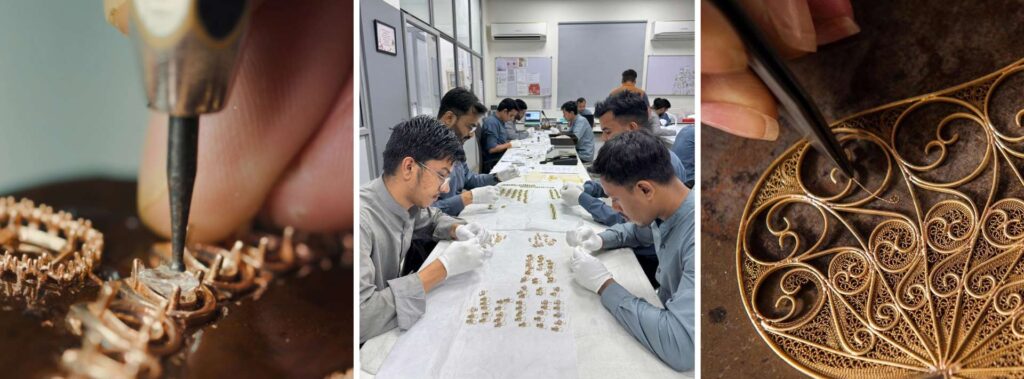
Looking for a specific manufacturing market? Deepwear can compare manufacturing options according to product complexity, materials, MOQ, finishing requirements, target price and production scale. That can be particularly useful when a collection combines several types of accessories rather than relying on one standardized product.
Designing for quality rather than mass production
Intricate accessories can expose manufacturing weaknesses quickly.
A poorly finished casting can leave rough edges. Delicate soldering can fail under repeated use. Heavy embellishment can make a hairpin uncomfortable or unstable. Plated finishes can wear differently depending on how frequently the piece is handled.
These considerations become more important when a design contains multiple moving or assembled components.
Quality-focused hair accessory manufacturing therefore starts before production.
1. Weight and balance
A beautiful accessory that continually pulls out of the hair has a product-development problem. Weight distribution, pin length and attachment mechanisms should be tested during sampling.
2. Surface finishing
For metal pieces, polishing, plating, enamel application and edge finishing can substantially affect the final appearance and perceived quality.
3. Component durability
Tassels, chains, beads and articulated decorations need attachment points capable of handling normal use.
4. Comfort
Decorative pieces worn close to the scalp require different considerations from a brooch or necklace.
5. Repairability and replacement
For higher-value pieces, replaceable decorative components or repairable construction can extend the product’s useful life.
Deepwear’s work in jewelry sourcing is relevant here because the same supplier-selection issues arise when a fashion accessory incorporates jewelry techniques. Our jewelry sourcing service covers materials, techniques, supplier matching and production expertise.
Our founder and CEO, Thoray d’Haese Sacoor, brings decades of fashion-industry and sourcing experience to a business built around knowledge of manufacturing markets and supplier relationships. Deepwear’s teams can help brands investigate whether a proposed accessory can realistically move from reference image to sample and eventually into production.
Have a concept but aren’t sure where it belongs? We can help identify the questions that need to be answered before approaching manufacturers. Book a consultation with our team.
Could hair accessories become the next collectible fashion category?
The renewed attention around ornate hair accessories points to a broader opportunity in how brands approach fashion accessories.
A mass-market hair clip can be primarily functional. A highly crafted hair ornament can become part of a personal collection.
That creates room for:
- Seasonal floral accessories
- Contemporary interpretations of historical hairpins
- Gemstone and metal hair jewelry
- Statement bridal and occasion accessories
- Collectible limited-edition pieces
- Convertible hair and jewelry accessories
- Textile-based sculptural hair ornaments
- Character-inspired accessories connected to entertainment and storytelling
- Small-batch artisan collaborations
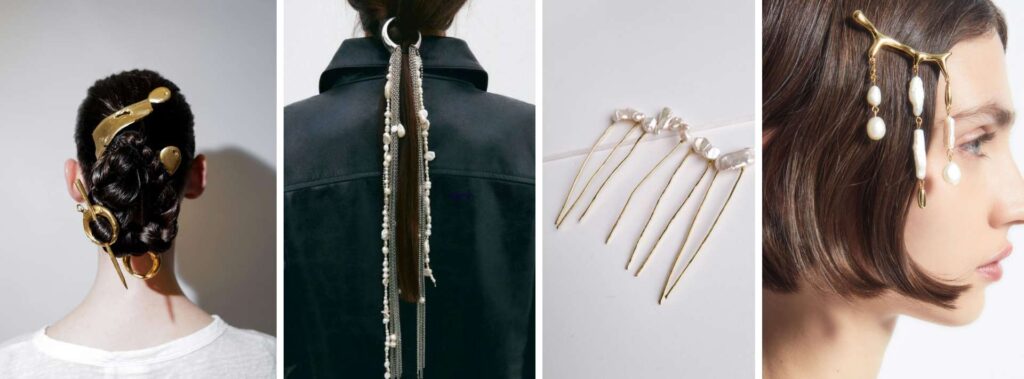
The opportunity is also not limited to historical aesthetics. The same construction principles can be translated into futuristic, minimalist, gothic, botanical, Art Deco or abstract designs.
The common factor is visible craftsmanship and a product that gives the customer a reason to keep it.
Deepwear has also explored how unusual materials can move from waste streams into jewelry products. Our recent Sustainable Jewelry Upcycling: Transforming Discarded Mussel Shells into Luxury Design looks at material processing, sourcing and manufacturing considerations around shell-based jewelry.
That same approach can apply to hair accessories: the material itself can become part of the product story when the manufacturing process supports it.
From cultural reference to commercial product
The global history of hair ornamentation shows that there is no single definition of what a hair accessory should be.
Japanese kanzashi demonstrate the possibilities of textile craftsmanship. Korean hairpins show how a structural object can carry cultural meaning. Indian hair jewelry demonstrates how closely head adornment can approach fine jewelry. Chinese hairpins demonstrate the potential of movement, layered construction and mixed materials.
For modern fashion brands, the lesson is not to reproduce these objects wholesale, but to recognize the design potential of hair accessories as crafted products. That means asking where a technique can be applied, which manufacturing ecosystem can support it, how much handwork is commercially realistic, and whether the finished piece provides enough value to justify its production cost.
At Deepwear, our local teams work across major sourcing markets to investigate those questions with brands, comparing supplier capabilities, materials and production options as a collection moves from concept toward manufacturing.
The next generation of intricate hair accessories may draw inspiration from many cultures, but developing them commercially requires a practical understanding of materials, construction, manufacturing capabilities and production requirements.
Whether you are developing intricate hair jewelry, exploring a new accessory category or looking for manufacturers capable of detailed craftsmanship, Deepwear can help you identify suitable sourcing markets and production partners. Talk to our team about your next accessory collection.