
Unpolished gemstones are reshaping luxury jewelry sourcing. Explore MOQ realities, global supply chains, and how to scale irregular materials in 2026.
Luxury jewelry is not moving toward unpolished gemstones because of aesthetics alone. It is reacting to a structural breakdown: standardized materials especially lab-grown stones no longer signal rarity.
A recent analysis from Forbes highlights raw diamonds as a countertrend. But that’s only one piece of a larger transformation.
Unpolished gemstones across diamonds, rubies, emeralds, and sapphires are forcing a complete rethink of sourcing, MOQ strategy, and production systems. This is not a design shift. It is a supply chain reset.
In this blog we cover:
- Why unpolished gemstones are reshaping luxury jewelry sourcing
- How lab-grown diamonds and standardization are reducing differentiation
- The global gemstone supply chain from extraction to production
- Real MOQ strategies across India, China, Vietnam, and beyond
- How to scale collections using irregular and non-standard gemstones
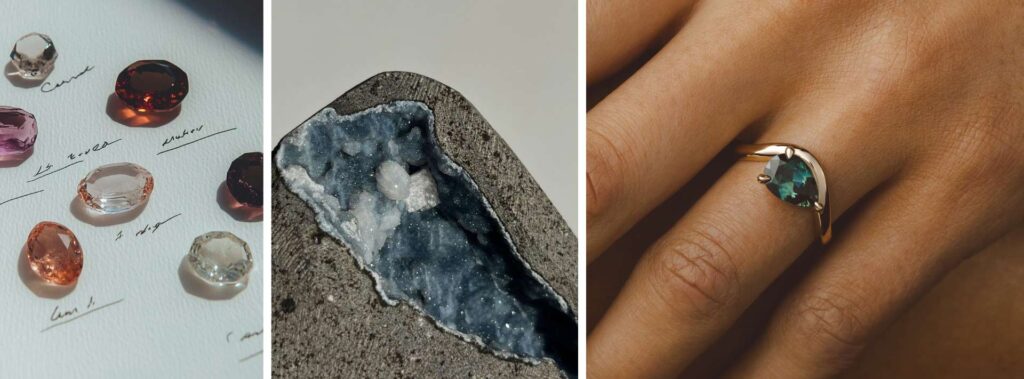
Standardization Has Flattened Luxury
For decades, the gemstone industry operated on a simple premise: value comes from perfection. That perfection was engineered through systems designed to eliminate variation and maximize visual consistency.
At its core, this meant:
- Precision cutting to achieve ideal proportions
- Clarity grading to minimize visible flaws
- Uniformity across stones to enable repeatable designs
This framework worked until it didn’t.
What once signaled rarity has become predictable. The industry didn’t fail; it over-optimized. When every stone is cut to the same standards, graded by the same metrics, and presented through the same visual language, differentiation collapses.
Lab-grown diamonds accelerated this breakdown dramatically. They didn’t introduce a new aesthetic; they replicated the existing one, but more efficiently:
- Same visual quality as natural stones
- Available at a fraction of the price
- Produced at effectively unlimited scale
The consequence is unavoidable: perfection is no longer scarce, and therefore no longer inherently valuable.
This is the gap unpolished gemstones are filling, but not in a superficial way. They reintroduce scarcity through properties that cannot be standardized:
- Irregularity in shape and structure
- Natural inclusions that cannot be engineered away
- Non-repeatable forms shaped by geological processes
These characteristics do something polished stones no longer can: they make each piece visibly distinct without explanation.However, this creates a new constraint. Unlike polished gemstones, unpolished stones resist traditional scaling models. You cannot mass-produce uniqueness using systems built for uniformity. This is where sourcing and production begin to diverge sharply from legacy practices.
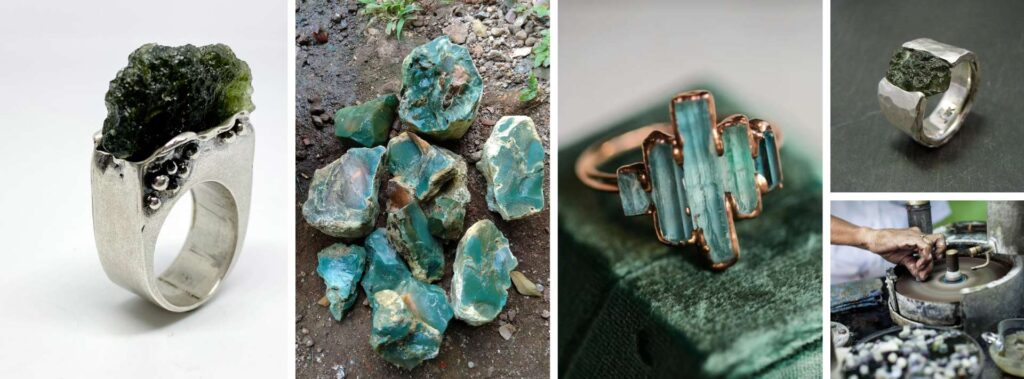
Step One: Where Gemstones Actually Come From
Before addressing how unpolished gemstones are used, it’s necessary to clarify where they originate and where most brands misunderstand the process.
The global gemstone supply begins in a relatively concentrated set of extraction zones:
- Rubies
- Mozambique → large-scale commercial supply
- Myanmar → historically premium, limited output
- Emeralds
- Zambia → consistent, scalable production
- Colombia → high-value, brand-recognized origin
- Sapphires
- Sri Lanka → long-standing, diverse supply
- Madagascar → high-volume, newer deposits
- Diamonds
- Africa, Canada, Russia → primary global sources
These regions define raw availability, not usability.
This distinction is critical. Extraction zones:
- Do not sort stones into production-ready categories
- Do not optimize for design compatibility
- Do not offer flexible MOQs aligned with brand needs
Instead, they produce mixed, unstructured output, often in bulk parcels where quality, size, and characteristics vary widely.
For brands working with unpolished gemstones, entering at this stage introduces immediate friction:
- High variability
- Limited selection control
- MOQ tied to mining output, not design intent
In practical terms, extraction is only the starting point. The real work begins after.
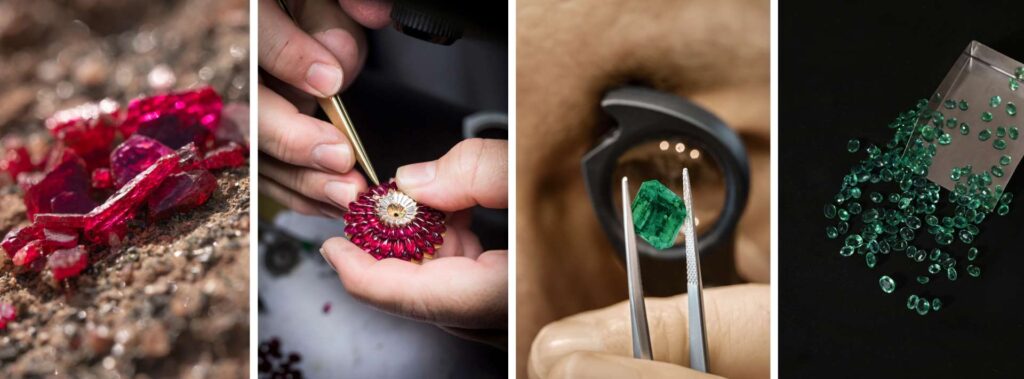
Step Two: Where Unpolished Gemstones Become Usable
Raw gemstones do not enter production directly. They must pass through stages where they are sorted, grouped, and made usable within a design and manufacturing context.
This is where our Deepwear team becomes relevant. We connect brands with the right suppliers, factories, and artisans, coordinating each stage so unpolished gemstones can move from raw material to finished collection without breakdowns:
1. India
India functions as one of the most critical nodes in the global gemstone trade. It is where raw output begins to take shape as usable inventory.
Its role is defined by scale and structure:
- Large-scale aggregation of rough stones from multiple origins
- Systematic sorting and grading across size, color, and quality
- Established pipelines for both diamonds and colored gemstones
This transforms fragmented mining output into something actionable.
MOQ Reality:
- Bulk purchasing: 100–1000+ stones
- Negotiated access: ~50–200 stones with established suppliers
What this enables:
- Selection within variability
- Formation of semi-consistent batches
- Initial alignment between material and design intent
In effect, India converts raw supply into structured possibility.
2. China
If India organizes variability, China operationalizes it.
China’s role is often underestimated because it does not dominate extraction. Instead, it excels at what matters more for unpolished gemstones: adapting irregular materials into scalable production systems.
Its capabilities include:
- Advanced stone processing, including handling non-standard shapes
- High-capacity jewelry manufacturing infrastructure
- Integration between material handling and production workflows
Crucially, China can work with semi-irregular inputs without forcing full standardization.
MOQ Reality:
- Typically 50–300 units per design
- Flexible enough for mid-scale collections
What this enables:
- Translation of irregular stones into repeatable (but not identical) products
- Balance between uniqueness and production efficiency
China effectively bridges the gap between material complexity and commercial scalability.
3. Vietnam
Vietnam does not play a major role in gemstone sourcing, but it has become relevant in how collections are developed and tested.
Its advantages are operational:
- Expanding jewelry manufacturing capabilities
- Competitive labor costs
- Greater flexibility compared to more rigid production hubs
MOQ Reality:
- 50–150 units
- Lower thresholds for experimental runs
What this enables:
- Pilot collections using unpolished stones
- Iterative development before scaling
- Reduced risk when working with non-standard materials
Vietnam functions as a controlled testing environment within the supply chain.
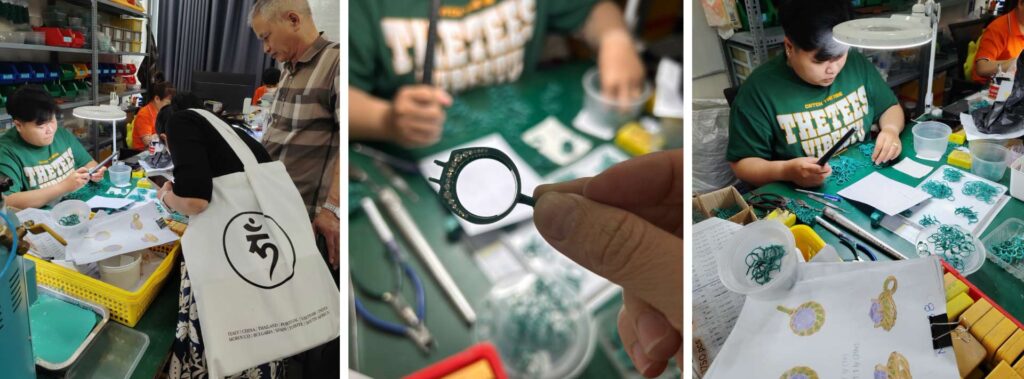
4. Turkey
Turkey operates on a different axis: not scale, but distinction.
It contributes:
- Access to rare and specialty gemstones
- Regional aggregation and trade networks
- Strong craftsmanship traditions in jewelry making
MOQ Reality:
- 20–100 stones for specialized sourcing
What this enables:
- Differentiation at the material level
- Integration of uncommon stones into collections
Turkey does not support volume, but it enhances identity and uniqueness.
5. Bangladesh
Bangladesh enters the process after material and design have stabilized.
It is not involved in gemstone sourcing, but it plays a critical role in scaling:
- High-efficiency production environments
- Cost-effective labor structures
- Capacity for larger production runs
MOQ Reality:
- 100–500+ units
What this enables:
- Transition from small-batch experimentation to commercial volume
- Cost control in labor-intensive processes
Bangladesh is where collections move from concept to consistent output.
MOQ Disclaimer: The minimum order quantities (MOQs) outlined above are indicative ranges based on typical supplier and manufacturing conditions. Actual MOQs may vary depending on factors such as gemstone type, quality, availability, customization requirements, and supplier capabilities. Final MOQs are determined on a case-by-case basis during sourcing and production planning.
Step Three: Europe’s Role is Control, Not Extraction
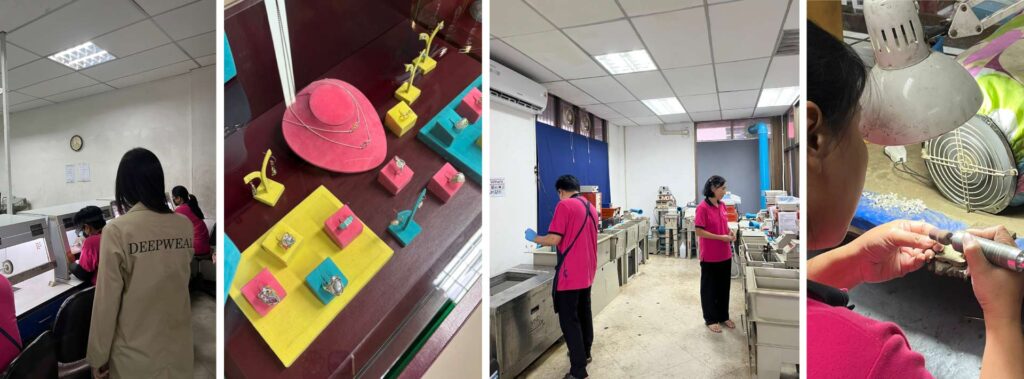
Deepwear’s European presence across Portugal, Bulgaria, and North Macedonia, to name a few, is not focused on gemstone sourcing or raw production.
Instead, this is where we stay close to the market.
Our role in these regions is centered on:
- Working directly with our client base across Europe
- Aligning production with EU market expectations
- Managing communication, timelines, and quality standards
- Supporting logistics and delivery into key luxury markets
This layer ensures that what is produced across our network is not just technically complete, but commercially viable.
Functionally, our European presence acts as:
- A point of coordination between brands and production
- A checkpoint for quality and consistency
- A direct link to the end market
If you’re developing a collection using raw or irregular gemstones, our team works directly with you to map sourcing, MOQ, and production into a single, workable pipeline. Get in touch with Deepwear to explore how your collection can move from concept to production without unnecessary risk or inefficiency.
How can brands work with unpolished gemstones without increasing costs or production risk?
Working with unpolished gemstones does not automatically mean higher costs or inefficiency, but it does require a different operational approach. The key is to control where variability enters the process. Instead of sourcing directly from fragmented supply, brands should work through aggregation and processing hubs like India and China, where stones can be sorted into usable batches with more predictable characteristics. From there, production should start with small pilot runs in flexible environments such as Vietnam before scaling in larger manufacturing bases. This staged approach allows brands to test designs, stabilize settings, and align MOQs with actual demand. This may work in reducing material waste, minimizing redesign cycles, and preventing cost overruns. In practice, the risk is not the material itself, but how early brands commit to scale without first structuring variability.
Where Strategy Meets Production
Unpolished gemstones can signal uniqueness, but they are not a requirement for building a strong jewelry collection. Some brands will continue with polished stones. Others will work with lab-grown. Some will experiment with raw materials.
There is no single correct direction.
What matters is whether the sourcing and production process can support the choice being made. Unpolished gemstones simply make the gaps more visible. They expose where supply chains are rigid, where MOQs are misaligned, and where production cannot adapt.
That is where most collections fail. Not at the idea stage, but in execution.
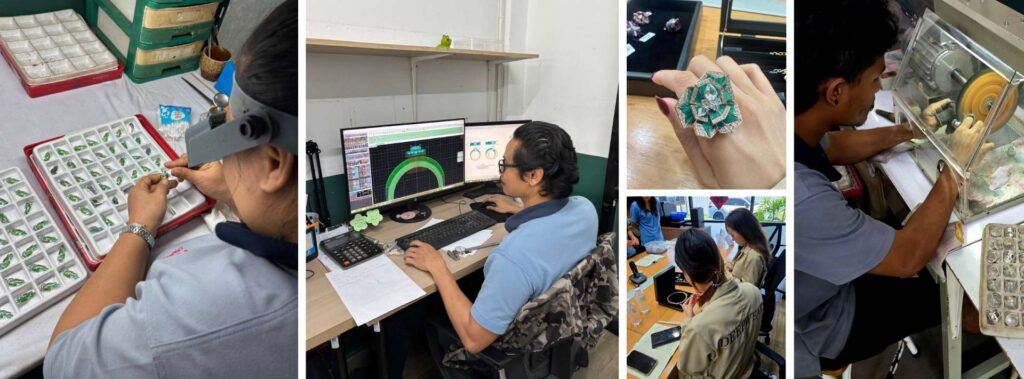
At Deepwear, our role is straightforward. We work with brands to structure sourcing, coordinate with suppliers and manufacturers, and make sure production runs according to plan. Whether the collection uses unpolished gemstones or not, the goal is the same: to make it workable.
If you are developing a jewelry collection and need support across sourcing and production, contact our team to discuss how to move it forward without unnecessary friction.