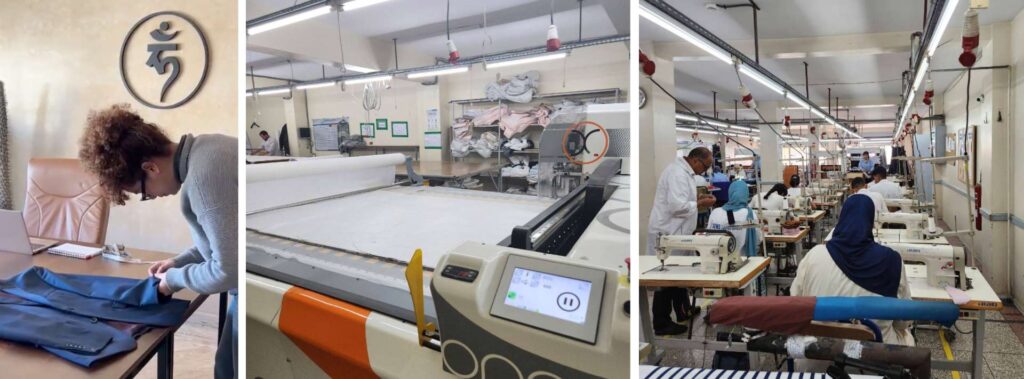
Why Morocco has become a strategic nearshoring hub in 2026. Speed, trade advantages, and manufacturing resilience for fashion brands facing tariff volatility.
In 2026, global fashion manufacturing is no longer shaped by one-off crises. It is shaped by permanent uncertainty. The United States’ renewed provocations, recurring tariff threats, and transactional trade posture have reintroduced a familiar reality for brands selling into the US: supply chains can become political targets overnight.
Deepwear has explored this pattern before—across blogs on nearshoring, tariff exposure, and sourcing diversification beyond Asia. The conclusion has been consistent: brands that rely on long, fragile supply chains are the most exposed. Brands that survive are those that can move production closer, react faster, and qualify for preferential trade treatment.
In this context, Morocco is no longer an “emerging option.” In 2026, it is a strategic manufacturing hedge.
In this blog we cover:
- Morocco’s role in nearshoring fashion manufacturing in 2026
- How tariff volatility is influencing sourcing decisions for US and EU brands
- Speed-to-market and logistics advantages of manufacturing in Morocco
- Key US–Morocco and EU trade rules brands need to understand
- The importance of local manufacturing expertise and coordination
Strategic Context: Morocco’s Manufacturing Renaissance
Morocco is in the middle of a full-scale manufacturing renaissance, quietly transforming itself into one of the most advanced nearshore apparel hubs serving both Europe and the United States.
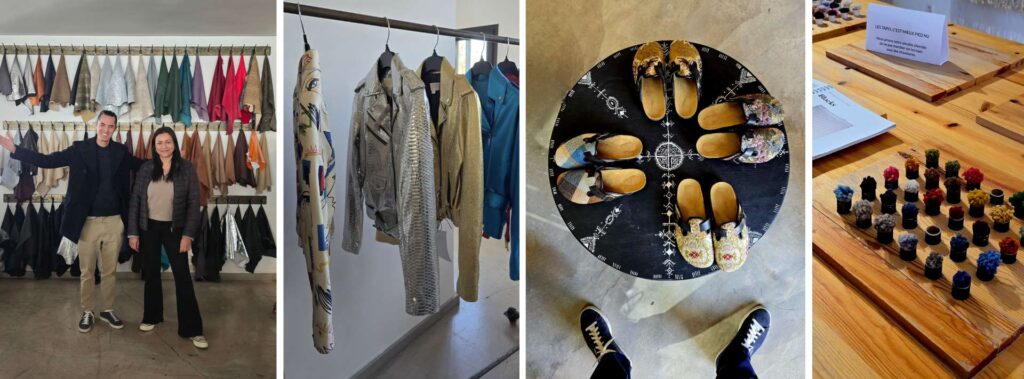
Building on foundations such as geographic proximity, strong trade agreements, and growing industrial depth—Morocco has now layered in Industry 4.0 capabilities. AI-driven quality control, automated cutting rooms, and real-time production monitoring are no longer exceptions; they are becoming standard across Tier 1 factories.
This industrial acceleration coincides with unprecedented infrastructure investment. Global events such as the Africa Cup of Nations and the upcoming 2030 World Cup have pushed ports, roads, energy systems, and logistics networks to all-time operational readiness.
In 2026, Morocco’s manufacturing capacity is organized around specialized regional hubs. Casablanca focuses on knitwear, premium jersey, and tailored garments, offering high-quality production well suited for EU brands. Tangier is optimized for fast fashion, short runs, and rapid repeats, with the ability to move orders from production to truck within 48 hours. Fez and Meknes specialize in wovens and industrial apparel, supported by integrated manufacturing plants that deliver scale, verticality, and cost efficiency.
Morocco now produces approximately 1 billion garments annually, supported by major investments such as the Sunrise Group’s $250M integrated facilities in Fez—adding over 50 million units of end-to-end capacity from spinning to sewing.
Planning to diversify production or reduce tariff exposure?
Speak with Deepwear’s sourcing team to evaluate whether Morocco fits your nearshoring strategy and production timelines.

Advantages vs. Disadvantages: The Reality Brands Must Accept
Morocco is not a low-cost miracle. It is a high-speed, high-compliance manufacturing environment. Understanding both sides is essential.
The Strategic Advantages
Speed to Market
In a tariff-volatile world, speed is risk mitigation. From Tangier, finished goods can reach:
- Madrid in 24 hours
- Paris in 48 hours
- London in 72 hours
Deepwear has consistently emphasized that nearshoring is no longer about convenience—it is about reducing exposure to policy shocks. Morocco allows brands to react to demand signals instead of forecasting six months ahead.
Sustainability & Energy Transition
Morocco’s national grid now runs on 40–45% renewable energy, driven by large-scale solar and wind projects. For brands navigating EU Green Deal reporting, CBAM exposure, and Scope 3 emissions audits, this materially lowers compliance risk compared to Asia-based production.
Trade Agreement Strength
Morocco remains:
- The only African country with a comprehensive Free Trade Agreement with the United States
- Deeply integrated with the EU through long-standing association agreements
At a time when Trump-era tariff logic penalizes Asian imports broadly, Morocco offers rule-based, defensible market access.
Morocco’s manufacturing ecosystem also presents structural challenges that brands must account for. More than 70% of fabrics are imported, primarily from Turkey and Italy, making fabric sourcing and coordination critical. Rising labor costs, driven by the 2026 SMIG increase, now position Morocco above lower-cost markets such as Egypt and Bangladesh.
In addition, origin and labeling complexity—particularly related to Western Sahara regulations—requires strict documentation and compliance. As a result, Morocco rewards careful planning rather than improvisation, and brands without strong fabric control or origin expertise often face difficulties.
Trade Rules and Logistics in 2026
In 2026, Morocco’s strength as a nearshoring base comes from the alignment of two factors: preferential trade access and fast, reliable logistics. Trade agreements determine whether garments qualify for duty-free entry; logistics determines how quickly that advantage turns into revenue.
United States: The Yarn-Forward Reality
Under the US–Morocco Free Trade Agreement, garments can enter the US at 0% duty, provided they comply with Yarn-Forward rules. This structure rewards planning and penalizes shortcuts.
To qualify, brands must ensure:
- Yarn is spun in Morocco or the United States
- Fabric is knitted or woven in Morocco or the United States
- Assembly is completed in Morocco
Some brands rely on the Short Supply List for unavailable materials, but this requires precise documentation.
European Union: Revised Pan-Euro-Med (PEM) in Practice
For EU-bound production, Morocco benefits from the fully active revised PEM Convention as of January 1, 2026. The framework increases sourcing flexibility while maintaining preferential access.
Key advantages include:
- Diagonal cumulation, allowing fabrics from Turkey, Tunisia, or Egypt
- Double transformation rules, typically requiring fabric and garment production within the PEM zone
This enables Morocco to function as a dual-market production base for both the US and EU—a diversification strategy Deepwear has consistently advocated in response to tariff and policy volatility.
Logistics: Morocco’s Digital Trade Corridor
Once trade eligibility is secured, Morocco’s logistics infrastructure amplifies its value. Tanger Med has evolved into a digitally integrated trade corridor, enabling fast, predictable movement of goods.
In practical terms:
- Finished garments can reach Spain in 1–2 days
- Core EU markets within 3–4 days
- The US East Coast in approximately 15 days
As the EU’s 2026 Emissions Trading System increases the cost of long-distance shipping, these shorter routes now deliver operational, financial, and environmental advantages over farshore Asian production.
The Deepwear Advantage: Why Local Expertise Is Non-Negotiable
While Morocco offers speed, trade access, and industrial capacity, success is rarely automatic. The country’s manufacturing ecosystem rewards brands that plan carefully and coordinate well—particularly across fabric sourcing, production scheduling, and quality control.
Deepwear’s role in Morocco goes beyond factory access. Our on-the-ground teams can help brands execute nearshoring strategies with greater consistency and fewer disruptions by providing:
- Pre-vetted manufacturing partners aligned with ESG, compliance, and buyer standards
- Fabric and material coordination, including managing regional and triangular sourcing
- Structured quality control, with checks at key stages to reduce defects, rework, and returns
- Technical and production support, ensuring designs, patterns, and specifications translate accurately on the factory floor
- Cultural and operational fluency, supporting relationship-based manufacturing and smoother communication
The difference between success and failure is rarely the factory itself. It is the ability to align logistics, materials, timelines, and execution consistently and at speed.
Why are fashion brands nearshoring production to Morocco in 2026?
Brands are nearshoring to Morocco to reduce tariff exposure, shorten lead times, and gain preferential access to US and EU markets. Morocco combines speed-to-market, strong trade agreements, and growing manufacturing capacity, making it a strategic hedge against global uncertainty.
Does Morocco qualify for duty-free access to the US and EU?
Yes, under specific conditions. The US–Morocco FTA allows duty free access if yarn forward rules are met. For the EU, Morocco benefits from the revised Pan Euro Med Convention, enabling diagonal cumulation with select countries.
Morocco, Relationships, and Resilient Planning in 2026
Trade agreements, particularly in politically volatile periods, can shift quickly. Tariff policies can change with administrations, negotiations, or headlines. What tends to endure, however, are longstanding manufacturing ecosystems and business relationships built over decades.
Morocco is not a sudden alternative created by uncertainty—it is a country with a long history in textile and garment manufacturing that is now expanding, modernizing, and strengthening its position through nearshoring, infrastructure investment, and technological upgrades. Its value in 2026 lies not only in trade access, but in proximity, experience, and adaptability. For brands navigating an uncertain global landscape, Morocco offers a way to take reasonable precautions without overreacting: shortening supply chains, improving speed to market, and maintaining flexibility across both US and EU channels. With the right planning, it can function as a stable and scalable component of a diversified sourcing strategy.
Local expertise and strong coordination remain important in making this work smoothly. Our teams with on-the-ground experience can help brands navigate logistics, compliance, and production realities more efficiently, while allowing long-term relationships to do what they do best: sustain manufacturing through changing political cycles.
In that sense, Morocco is less a bet on policy and more a bet on experience, proximity, and continuity.
Considering Morocco as part of your 2026 sourcing strategy? Deepwear helps brands evaluate feasibility, manage trade compliance, coordinate fabrics, and execute nearshoring production with local teams on the ground. Contact us to structure a faster, more resilient supply chain.