
A 2026 deep dive into China’s Pearl River Delta fashion manufacturing ecosystem: speed, scalability, MOQs, product development strengths, and why on-the-ground expertise matters.
The Pearl River Delta (PRD) continues to stand as one of the most powerful and relevant fashion manufacturing ecosystems in the world. As brands diversify production across Southeast and South Asia, few regions can match the PRD’s unique combination of speed, development intelligence, execution certainty, and scalability.
Stretching across Guangzhou, Shenzhen, Dongguan, Foshan, and Zhongshan, the PRD has evolved far beyond its reputation as a low-cost production hub. Today, it is the backbone behind some of the world’s fastest-moving and most disruptive fashion brands — an ecosystem engineered for constant iteration, rapid testing, and commercial execution.
For brands that need to move quickly, respond to demand in real time, and scale without losing control, the PRD is not optional — it is strategic.
In this blog we cover:
- Why the Pearl River Delta remains a strategic fashion manufacturing hub in 2026
- The types of brands and product categories best suited to PRD production
- What truly differentiates the PRD: speed, development depth, and scalability
- Structural strengths, operational challenges, and MOQ realities in the region
- How Deepwear helps brands navigate complexity without sacrificing control
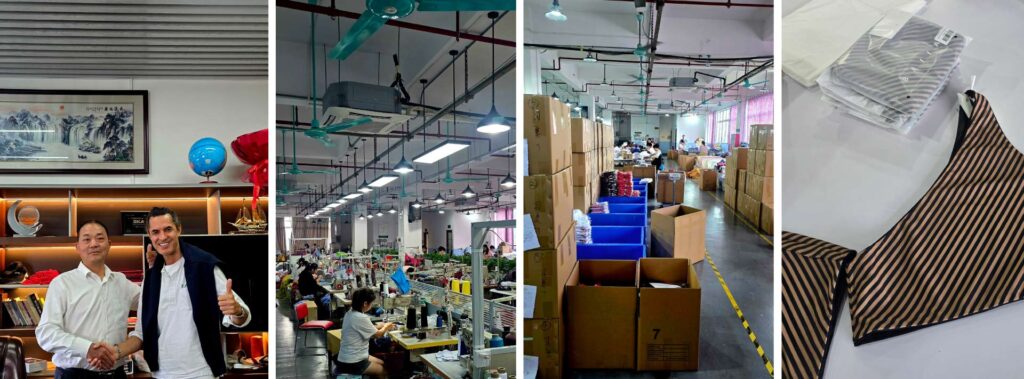
Overview of Garment & Accessories Manufacturing in the PRD (2026 Outlook)
Over the past decade, the PRD has transformed in line with the realities of modern fashion. Traditional long lead-time, seasonal production has given way to shorter cycles, continuous drops, and data-driven replenishment.
By 2026, the PRD is particularly well suited for:
- Digital-native and DTC brands
- Fast and ultra-fast fashion models
- Trend-driven contemporary labels
- Sportswear, activewear, and performance brands
- Accessories-led lifestyle concepts
This ecosystem is built to support rapid product turnover and high SKU counts — enabling brands to test, learn, and scale faster than almost anywhere else in the world.
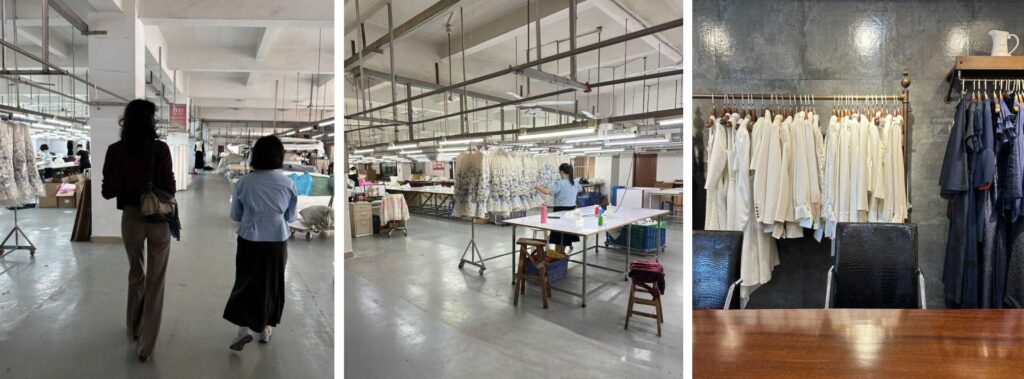
Core Product Specialties
Accessories production in the PRD benefits from concentrated material ecosystems and hardware supply chains.
| Category | Strength Area |
| Bags | PU, leather, hybrid constructions, fast development cycles |
| Small leather goods | Structured production with consistent quality control |
| Fashion accessories | High-SKU, trend-responsive programs |
| Headwear | Scalable production with flexible order volumes |
Beyond individual categories, what distinguishes the PRD is execution depth — the ability to refine, re-engineer, and commercially optimise a product before scaling it.
What Truly Differentiates the PRD
PRD’s strength lies in how the ecosystem is structured; deliberately engineered to support speed, adaptability, and commercial execution at scale. What sets the PRD apart is not a single advantage, but a combination of interlocking capabilities that allow brands to move faster, smarter, and with greater certainty than in most other manufacturing regions.
These core factors define why the PRD remains a strategic production base in 2026:
1. Speed as a System
In the PRD, speed is not a competitive advantage — it is the baseline.
- Sampling can begin within days
- Design revisions are executed rapidly
- Development and production often overlap
This system enables frequent drops, rapid trend response, and compressed time-to-market.
2. Advanced Product Development
PRD factories actively collaborate with brands on:
- Pattern optimisation
- Construction refinement
- Cost engineering
- Material substitution
This hands-on development capability significantly reduces risk and improves commercial viability.
3. Fashion Sensitivity
Manufacturers are deeply connected to:
- Local wholesale and trend markets
- Domestic e-commerce platforms
- Global fashion movements
This gives PRD suppliers strong commercial awareness — they understand what sells, not just how to make it.
4. Scalable at Speed
Few regions can scale as efficiently:
- From small test orders
- To rapid replenishment
- To large-volume programs
This makes the PRD ideal for brands operating in uncertain or demand-driven environments.
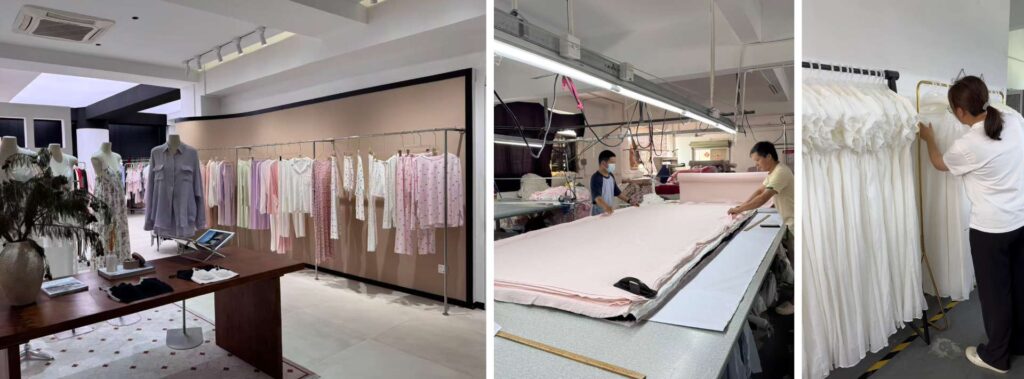
Structural Strengths — And Why Navigation Matters
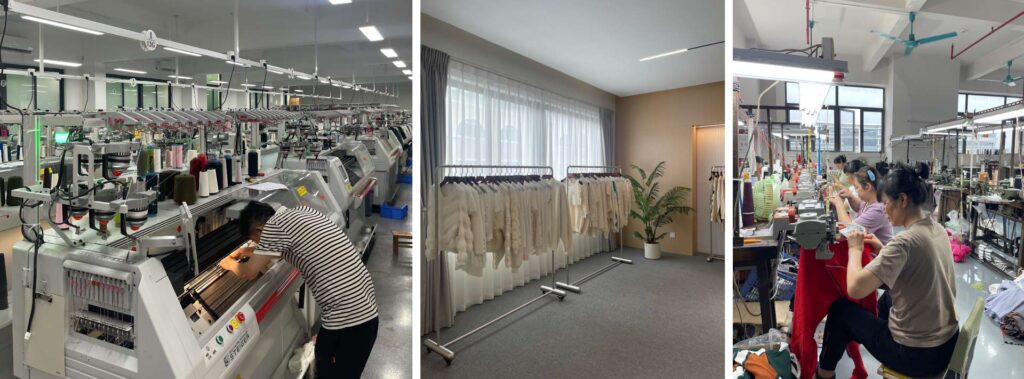
The Pearl River Delta’s effectiveness as a manufacturing base is driven by the depth and integration of its ecosystem. Brands operating in the region benefit from a combination of human expertise, infrastructure, and supply chain maturity that is difficult to replicate elsewhere.
Key structural strengths include:
- Skilled workforce — experienced technicians, sample makers, merchandisers, and production managers accustomed to fast development cycles and complex production requirements
- World-class infrastructure — proximity to major export ports, dense logistics networks, and tightly clustered industrial zones that reduce lead-time friction
- Unmatched supply chain density — local access to fabrics, trims, dyeing, printing, embroidery, washing, and specialty finishing processes, enabling speed and flexibility
- Compliance maturity — strong familiarity with BSCI, SEDEX, WRAP, ISO, and evolving ESG standards
These strengths allow brands to operate with high levels of productivity and execution reliability. While labour and compliance costs have increased, efficiency and coordination across the ecosystem often offset higher unit costs, particularly for brands that value speed and consistency.
At the same time, the PRD’s sophistication introduces operational complexity. Brands must contend with:
- Rising labour and compliance costs
- Capacity constraints at top-performing factories
- Intense competition for production slots
- Exposure to tariffs, trade policy changes, and currency fluctuations
Without local expertise, these factors can disrupt timelines and erode margins. With informed navigation and structured oversight, however, they become manageable — and often strategic — allowing brands to leverage the PRD’s strengths without sacrificing control, quality, or commercial clarity.
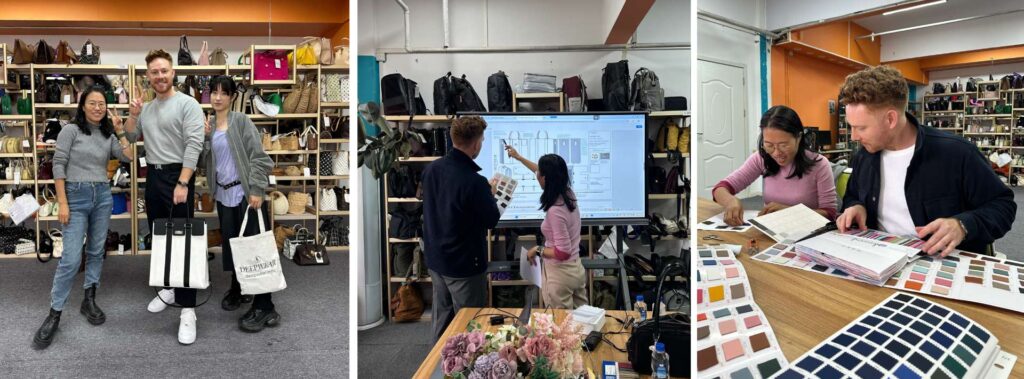
MOQ Reality in the PRD
Typical MOQs in 2026 reflect the region’s scale-oriented efficiency:
| Category | Typical MOQ Range (per style / colour) | Lower MOQ Conditions | When MOQ Increases |
| Knitwear (Cut & Sew Jersey) | 300 – 1,000 pcs | Around 300 pcs is possible when using stock (in-house) fabric | Custom-dyed or developed fabrics usually increase MOQ to 500–800+ pcs. Most commercial orders fall between 500–1,000 pcs |
| Woven Garments | 300 – 1,500 pcs | About 300 pcs achievable with stock fabric and simple construction | Custom fabrics, structured tailoring, or special trims often raise MOQ to 800–1,500 pcs |
| Activewear | 500 – 2,000 pcs | Around 500 pcs possible for basic performance styles | Technical fabrics, compression materials, or seamless construction typically require higher volumes |
Note: Lower quantities are often possible, but pricing will increase accordingly. MOQ flexibility depends on the supplier, fabric sourcing, material type, construction complexity, and quality requirements. In many cases, fabric mill minimums — not just sewing capacity — determine the final production threshold.
Trims, Fabrics & Material Access
The PRD offers strong material advantages:
- Extensive local trims availability
- Robust fabric R&D and sampling capability
- Fast testing and development timelines
Some premium or niche materials may require importation, which can increase lead times and costs. Strategic material planning is therefore critical to maintaining speed.
Why Deepwear Is Essential in the PRD
The Pearl River Delta rewards brands that understand how to work within its complexity — and can be challenging for those without local insight. While the region offers exceptional speed and scalability, its density, competition, and pace benefit from careful navigation to avoid unnecessary risk and inefficiency.
Deepwear provides on-the-ground expertise through our Guangzhou-based team, operating as an extension of your brand rather than a transactional sourcing agent. Our role is to help translate PRD production realities into structured, workable processes that support your commercial goals.
How Deepwear Creates Advantage
Deepwear’s approach goes beyond factory introductions. We focus on aligning production decisions with product requirements, order volumes, and timing expectations, while supporting consistency and margin clarity.
Key areas of support include:
- Strategic factory matching based on product category, volume, and speed needs
- MOQ, pricing, and capacity discussions informed by current market conditions
- Compliance verification, audit coordination, and risk awareness
- Production planning, monitoring, and quality oversight
Value Beyond Sourcing
Our involvement extends into development and ongoing vendor coordination, helping brands maintain continuity as programs grow.
This includes:
- Hands-on product development support during sampling and refinement
- Transparent cost structures that support informed decision-making
- Vendor performance management across seasons and programs
- Direct, real-time communication with factories
By aligning PRD production capabilities with your brand strategy, Deepwear helps balance speed and scale with control, quality, and long-term commercial sustainability.
Conclusion
By 2026, the Pearl River Delta remains one of the most sophisticated and powerful fashion manufacturing ecosystems in the world. For brands that need speed, intelligence, and scalable execution, the PRD is not a compromise — it is an advantage.With Deepwear as your local partner, that advantage becomes structured, predictable, and commercially sustainable. Speak to our teams today!